
With so many types of 3D printer filament available, but picking up the wrong spool can lead to print failure, wraped corners, or parts that snap under the slightest pressure.
In this guide, we will cover everything from beginner-friendly classics to heavy-duty engineering materials, special composites, and crucial storage tips to keep your prints looking crisp.
3D Printer Filament Basics
Before we jump into specific materials, let’s cover some fundamental concepts. Not every 3d filament behaves the same way, and your machine needs to be set up to handle what you feed it.
Filament Diameters: 1.75 mm vs. 2.85 mm / 3.00 mm
When it comes to plastic spools, you will notice two main sizes: 1.75 mm and 2.85 mm (often loosely called 3.0 mm).
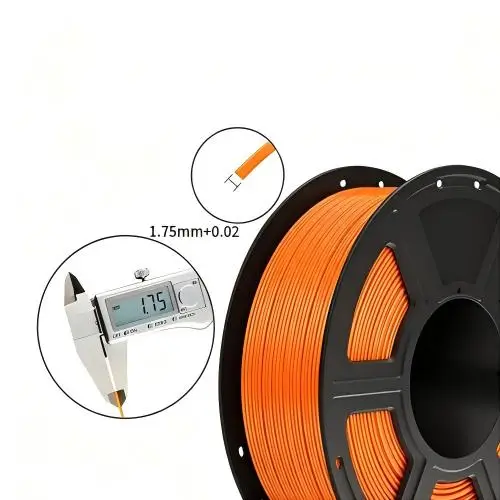
- 1.75 mm: This is the standard diameter for almost all desktop 3D printers. It melts faster, requires less extruder torque, and offers finer flow control.
- 2.85 mm / 3.0 mm: You will mostly find this size on older industrial machines or specific brands like Ultimaker. It provides stiffer pushing force in Bowden setups, but it is far less common today.
If you are using a standard modern printer, stick to 1.75 mm.
Key Factors to Consider When Choosing Filament
When evaluating different types of 3D printing filament, consider these core factors:
- Printability & Ease of Use: Does it stick to the bed easily, or does it warp at the slightest draft?
- Mechanical Strength & Impact Resistance: Will the part carry a load or survive being dropped?
- Flexibility & Elongation: Does the material need to bend and spring back, or remain rigid?
- Thermal & Chemical Resistance: Will your printed object sit in a hot car, stay outside in the sun, or touch oils and solvents?
- Price & Availability: Standard plastic is cheap, but exotic blends can quickly get pricey.
- Hardware Requirements: Some materials require an enclosed build chamber, high-temperature hotends (above 250°C), or hardened steel nozzles.
Common Types of 3D Printer Filament
If you are just getting started, about 90% of your printing will happen with these three standard types of 3D printer filament.
- PLA → Easy to print
- PETG → Balanced & Tough
- ABS → Heat-Resistant & Strong
PLA (Polylactic Acid)
It is the most popular entry-level 3d printing filament. Made from renewable resources like cornstarch or sugar cane, PLA is an eco-friendly thermoplastic that melts at low temperatures and smells slightly sweet when printing.
Key Properties: Plant-based/biodegradable, easy to print, low warp, low melting point.
Pros:
- Extremely easy to print with almost zero warping.
- Low odor while printing.
- Comes in hundreds of colors, silk finishes, and translucent tints.
Cons:
- Quite brittle; snaps rather than bends under heavy load.
- Low heat resistance—starts softening around 55°C–60°C (130°F). Leave a PLA print on a hot car dashboard in the summer, and it will droop like warm chocolate.
Best Uses: Visual prototypes, board game miniatures, display models, cosplay props, and everyday decorative items.
PETG (Polyethylene Terephthalate Glycol)
PETG has a perfect balance between the flexibility of PLA and the strength of ABS.
Key Properties: Strong, flexible compared to PLA, moisture/chemical resistant.
Pros:
- Stronger and far more impact-resistant than PLA.
- Higher temperature tolerance (softens around 75°C–80°C).
- Weather-resistant and UV-stable enough for outdoor use.
- Recyclable and food-safe in raw resin form (though printed layer lines can still harbor bacteria).
- Prints without needing a fully sealed enclosure.
Cons:
- Prone to stringing and “hairy” prints if print settings aren’t dialed in.
- Extremely sticky—it can stick too well to glass beds and rip chunks out of them if you don’t use a release agent like glue stick or hairspray.
- Highly hygroscopic (absorbs moisture from the air quickly).
Best Uses: Water-resistant containers, mechanical brackets, snap-fit clips, functional household objects, and garden gear.
Explore the difference between PLA and PETG filament: PLA vs. PETG Filament: Which 3D Printer Filament Should You Use?
ABS (Acrylonitrile Butadiene Styrene)
Long before PLA dominated home workshops, ABS was the traditional engineering plastic. If you have ever played with LEGO bricks, you have held ABS. It is tough, impact-resistant, and handles heat remarkably well.
Key Properties: Tough, heat-resistant (up to 95°C–100°C), durable, lightweight.
Pros:
- Excellent mechanical strength and impact resistance.
- Withstands high operating temperatures without warping after printing.
- Can be sanded, drilled, and post-processed with acetone to create a glass-smooth mirror finish.
Cons:
- If cold air hits the print, it will cause obvious warping, causing layers to split apart.
- Requires a hot build plate (100°C+) and an enclosed printer.
- Releases unpleasant, toxic styrene fumes while melting (proper ventilation is a must).
Best Uses: Functional automotive parts, snap-fit enclosures, electronic housings, high-impact toys, and high-heat mounting brackets.
Advanced & High-Performance 3D Filaments
When basic plastics won’t cut it, you need high-performance materials engineered for flexibility, extreme wear, or harsh outdoor conditions.
TPU / TPE (Thermoplastic Polyurethane / Elastomer)
Ever wanted to print something rubbery that you can squish, bend, or stretch? That is where TPU comes in.
Unlike rigid plastics, TPU acts like a firm rubber. You can print anything from squishy stress balls to rugged protective cases.
Key Properties: Rubber-like elasticity, high elongation before breaking, shock-absorbing.
Pros:
- Virtually indestructible layer adhesion—you simply cannot tear parts apart with your bare hands.
- Great resistance to wear, oils, and grease.
- Excellent impact absorption.
Cons:
- Printing TPU can feel like pushing cooked spaghetti through a thin straw.
- Requires very slow printing speeds (15–30 mm/s).
- Extremely difficult to print on Bowden extruders; a direct-drive extruder setup works best.
Best Uses: Smartphone cases, drone bumpers, RC car tires, vibration dampeners, gaskets, and flexible seals.
Nylon (Polyamide)
Nylon is a dominant material in the industrial tabletop manufacturing field. It boasts extremely high strength, a smooth surface and a low friction coefficient. It can be largely bent before sustaining permanent damage.
Key Properties: High tensile strength, flexibility under load, exceptional wear resistance.
Pros:
- Extremely durable and resistant to mechanical wear.
- Self-lubricating qualities make it brilliant for moving parts.
- Strong layer bonding when printed correctly.
Cons:
- Very sensitive to moisture. Wet Nylon boils inside the nozzle, creating pops, weak layers, and ruined prints.
- High tendency to warp—requires high bed heat and careful bed adhesion techniques.
Best Uses: Custom gears, mechanical hinges, bushings, power tool housings, and heavy-duty load-bearing components.
ASA (Acrylonitrile Styrene Acrylate)
ASA is the weather-proof alternative to ABS. When left outdoors, standard ABS degrades, turns yellow, and becomes brittle under sunlight. ASA, on the other hand, shrugs off UV rays effortlessly.
Key Properties: UV-resistant, weather-proof, high heat tolerance, durable.
Pros:
- Outstanding outdoor performance that won’t yellow or degrade over time.
- Matches the mechanical strength and heat resistance of ABS.
- Can be smoothed with acetone fumes just like ABS.
Cons:
- Releases toxic fumes during printing (needs good ventilation).
- Requires an enclosure and high bed temperatures to control warping.
Best Uses: Exterior automotive trim, outdoor light fixtures, garden tool handles, mailbox parts, and marine gear.
PC (Polycarbonate)
If you need the absolute strongest material available for standard desktop machines, Polycarbonate is the undisputed champ. PC is the same material used to manufacture bulletproof glass, motorcycle helmet visors, and heavy-duty riot shields.
Key Properties: Unmatched impact strength, clear optical potential, thermal tolerance up to 110°C+.
Pros:
- Handles intense structural stress and heavy impacts without shattering.
- Retains its shape in high-temperature environments where other plastics melt.
Cons:
- Extremely demanding hardware requirements: hotend temperatures above 300°C and bed temperatures over 110°C.
- Warps heavily if temperature fluctuations occur.
- Highly hygroscopic—must be dried thoroughly before printing.
Best Uses: High-stress structural brackets, machinery guards, clear protective covers, heat shields, and automotive engine bay components.
Specialty & Composite 3D Printing Filaments
Beyond raw plastics, manufacturers often mix additives into a base plastic (usually PLA, PETG, or Nylon) to create unique visual effects or boosted structural performance.
Wood & Metal Composite Filaments
- Wood-Fill: Made by blending standard PLA with 20%–40% real pulverized wood fibers. Prints look, feel, and even smell like natural wood. You can actually stain and sand wood prints just like real timber.
- Metal-Fill: Combines plastic resin with real metal powders (copper, brass, bronze, or stainless steel). These prints come out noticeably heavy. Once polished with steel wool or tumbled in media, they glisten like real cast metal.
Carbon Fiber Reinforced Filaments
Carbon fiber filaments blend micro-carbon fibers into base materials like PETG, PLA, or Nylon.
The carbon fibers act like a structural skeleton, making the plastic extremely stiff, lightweight, and dimensionally stable. It also gives parts a gorgeous matte texture that hides print layer lines almost completely.
Note: Micro-carbon fibers are terribly abrasive. Standard soft brass nozzles will be ruined after printing just half a spool of carbon fiber. You must upgrade to a hardened steel or ruby-tipped nozzle before using it.
Soluble Support Filaments (PVA & HIPS)
When printing complex geometry with wild overhangs, you need support structures. Removing plastic supports manually can leave behind messy scars. Soluble support materials solve this problem on dual-extruder printers:
- PVA (Polyvinyl Alcohol): Water-soluble material typically paired with PLA. Once the print finishes, submerge the entire object in warm tap water, and the PVA supports melt away completely, leaving a pristine print behind.
- HIPS (High Impact Polystyrene): Works similarly, but paired with ABS. Dissolves in a liquid solvent called d-Limonene.
Visual & Aesthetic Specialty Filaments
- Silk PLA: Blended with elastomers to give finished parts a shiny, satin-like metallic luster.
- Glow-in-the-Dark: Infused with phosphorescent materials. (Warning: These additives are also abrasive, so use a hardened nozzle!)
- Color-Changing: Uses thermo-chromic or photo-chromic pigments that change color based on ambient temperature or sunlight exposure.
- Marble-Look: Standard light PLA speckled with small dark particles to give a stone-like finish.
Quick Reference Chart: 3D Printing Filament Types and Uses
| Filament Type | Print Ease | Strength | Heat Resistance | Best Application |
|---|---|---|---|---|
| PLA | Very easy | Moderate (Brittle) | Low (~55°C) | Visual models, prototypes, figures |
| PETG | Easy-Moderate | High (Tough) | Moderate (~75°C) | Mechanical parts, water containers |
| ABS | Hard | High (Impact) | High (~95°C) | Functional parts |
| TPU | Moderate-Hard | Extremely High | Moderate (~60°C) | Gaskets, phone cases, shock mounts |
| Nylon | Hard | Exceptional | High (~80°C+) | Gears, hinges, low-friction parts |
| ASA | Hard | High | High (~95°C) | Outdoor items, automotive trim |
| PC | Very Hard | Extreme | Very High (~110°C+) | Heavy structural components |
| Carbon Fiber | Moderate | Extremely Rigid | Varies by base | Lightweight rigid brackets |
Best Practices: Storing and Maintaining Your 3D Filament
The Moisture Problem
Most thermoplastics are hygroscopic, meaning they draw moisture straight out of the air.
When wet filament enters your hotend (200°C+), that trapped water instantly boils into steam. This creates tiny micro-explosions inside the nozzle.
Signs your 3d printer filament has absorbed moisture include:
- Crackling or popping sounds while printing.
- Excessive stringing and thin hairy webs across gaps.
- Rough, pimpled surface textures.
- Weaker layer adhesion (parts snap along print lines easily).
Simple Filament Storage Solutions
To keep your spools dry and printing smoothly, you can follow these methods:
- Desiccant Packs & Airtight Bins: Store sealed spools inside plastic storage tubs equipped with gasket lids and plenty of silica gel packs.
- Vacuum-Sealed Bags: Use vacuum sealing bags with hand pumps to suck out air for long-term storage.
- Active Filament Dryers: Invest in an active filament dryer box. These heated units warm the spool while printing, driving out moisture and keeping delicate materials like Nylon, PETG, and TPU dry.
Choosing Your Next Spool
Mastering the various types of 3d printer filament doesn’t mean you need to buy every type.
For 80% of everyday projects, PLA will be your reliable, go-to workhorse for beauty and ease. When you need structural parts that withstand drops, water, or light loads, reach for PETG. And when you need parts that survive outdoors or in high-heat conditions, step up to ASA or ABS.
As you get comfortable dialing in print speeds, retract settings, and temperatures, expand your toolkit with flexy TPU or sleek carbon fiber composites.
What is your 3D filament to print with right now, and what functional project are you planning to tackle next? Grab a fresh spool, level that print bed, and get creating.