
Introduction
The debate of PLA vs. Silk PLA is a central theme in modern 3D printing. While standard PLA remains the backbone of the industry, silk PLA has emerged as a premium alternative that offers undeniable aesthetic value. However, this visual boost comes with specific trade-offs in structural integrity and printing requirements.
This article explores the critical differences between standard PLA filament and silk PLA filament, providing the technical insights and procurement suggestion needed to dominate the 3D printing market.
What are These Filament: PLA and Silk PLA
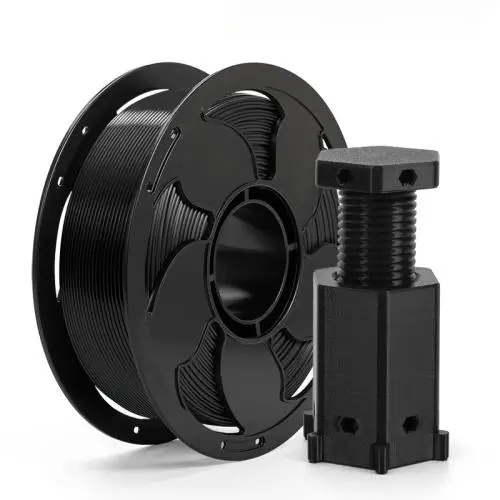
Standard PLA filament
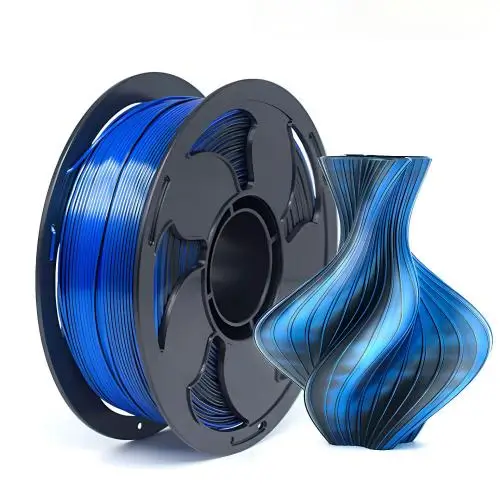
Silk PLA filament
Standard PLA Basics
PLA (Polylactic Acid) is the most mature and widely used 3D filament. Sourced from renewable resources like cornstarch and sugarcane, it is biodegradable under industrial conditions.
From a production standpoint, standard PLA filament is the “gold standard” for reliability. It prints at relatively low temperatures (190-220℃), exhibits minimal warping, and does not require a heated enclosure. For print farms and manufacturing hubs, this means stable, repeatable production on open-frame machines with high success rates.
What is Silk PLA?
Silk PLA = regular PLA + additives (soft polymers, plasticizers, mineral fillers)
These additives are responsible for the “silk” effect—a high-gloss, metallic-like sheen that hides layer lines and gives the final product a premium, “finished” look.
However, these same additives reduce the polymer’s internal bond strength and slightly increase the complexity of the printing process. It is important to note that silk PLA formulations vary between brands, making supplier evaluation a critical step for resellers.
Standard PLA vs. Silk PLA: A Quick Comparison
Quick Comparison Table
| Comparison Item | Standard PLA | Silk PLA |
|---|---|---|
| Ease of printing | Easiest; highest production yield | Slightly harder; needs parameter tuning |
| Nozzle temp | 190-220℃ | 210-230℃ |
| Bed temp | 55-60℃ | 55-65℃ |
| Strength | Baseline | Roughly 10-20% weaker |
| Stringing tendency | Low | Moderate to high (needs retraction tuning) |
| Finish | Matte to semi-gloss | High-gloss / stain sheen |
| Production yield | High | Slightly lower; requires strict control |
| Cost per kg | Lower, stable pricing | 20-50% premium depending on brand |
| Post-processing | Sandable, printable | Ready-to-ship surface (Sanding ruins finish) |
| Best for | Functional production parts, structural components | High-value aesthetic parts, gifts, display items |
Key Differences Summary
The core of the PLA vs. Silk PLA decision-making process lies in the balance between function and aesthetics.
Standard PLA is the workhorse. If your client requires a bracket, a housing for electronics, or a structural prototype, standard PLA is the logical choice. It provides the necessary stiffness and predictable dimensions required for industrial applications.
Silk PLA, on the other hand, is a marketing tool. It transforms a simple 3D print into a luxury item. For businesses selling decor, jewelry, or high-end display models, silk PLA allows for a higher retail price point without the need for labor-intensive post-processing like painting or vapor smoothing.
Ultimately, material selection determines project margin. Choosing silk for a functional part leads to failures and returns; choosing standard PLA for a trophy might lead to a “cheap” perception.
Is Silk PLA Weaker Than Normal PLA?
One of the most frequent questions from manufacturing businesses is: Will it break?
In terms of tensile strength and layer adhesion, silk PLA filament is generally 10–20% weaker than its standard counterpart. The additives that create the beautiful shine act as “impurities” in the polylactic acid chain, slightly loosening the polymer’s internal structure.
Impact on Production
For decorative pieces, this strength reduction is negligible. However, for functional load-bearing parts, the difference is critical. If your end product involves stress, repeated flexing, or mechanical fastening, using silk PLA will largely increase your product return rates.
Product Categories to Avoid with Silk PLA
- Load-bearing parts: brackets, wall mounts, tool holders, mounting bases.
- Mechanical fasteners: Threads, snap-fits, and clips (they tend to crack along layer lines).
- Transmission parts: Gears and pulleys (the softer additives lead to rapid surface wear).
- Screw bosses: These often split when a screw is tightened due to lower hoop strength.
The Rule of Thumb: Functional products should always default to standard PLA filament or PETG filament.
How to Print Silk PLA Successfully
Is Silk PLA Harder to Print?
Slightly harder because additives keep the material in a molten state longer and flow more freely. So printing with silk PLA requires stricter parameter control and more frequent quality inspection.
Three Main Production Challenges:
- Stringing: Because it stays liquid longer, silk PLA is prone to “oozing” during travel moves.
- Narrower temperature window: To achieve the best shine, you must find the “sweet spot” (usually 210–230°C). Too cold, and the finish is dull; too hot, and stringing becomes uncontrollable.
- Slower cooling: Overhangs and bridges are more likely to sag.
Key Process Parameters for Batch Production
- Dry the filament: Silk is more hygroscopic than regular PLA. Dry at 55–60°C for 4–6 hours before printing.
- Tune retraction: Increase retraction distance and speed by 10–20% compared to your standard PLA settings.
- Temperature Towers: Every time you switch batches or suppliers, run a temperature tower. The gloss level changes drastically with every 5-degree increment.
- Speed Control: Reduce print speeds by 10–20%, especially for outer walls, to ensure the gloss is uniform across the entire surface.
Slicer Settings for Best Appearance
To maximize the visual appeal of silk PLA filament, your slicing strategy must differ from standard production.
- Layer height: Use 0.20 to 0.28mm on a 0.4mm nozzle. Surprisingly, slightly thicker layers often catch the light better, creating a more continuous “sheen” than ultra-fine layers.
- Wall count: Use at least 3–4 walls. This prevents the internal infill pattern from “telegraphing” through the surface, which can dull the silk effect.
- Photography Tip: If you are selling these products online, lighting is key. Use a single low-angle light source to create a highlight that runs the length of the part. Flat, overhead office lighting makes Silk PLA look like grey plastic.
A Note on Post-Processing: Unlike standard PLA, you cannot sand silk PLA. Sanding permanently kills the shine and leaves a white, scuffed mark that cannot be polished back. If your workflow involves painting, using silk PLA is a waste of money—stick to standard PLA filament.
Tips for Printing Silk Dual-Color PLA
“Dual-Color” or “Co-extrusion” silk PLA is currently a high-demand item. These filaments feature two colors extruded side-by-side in a single strand. While the visual impact is exceptional, they present unique challenges for print farms using AMS (Automatic Material Systems).
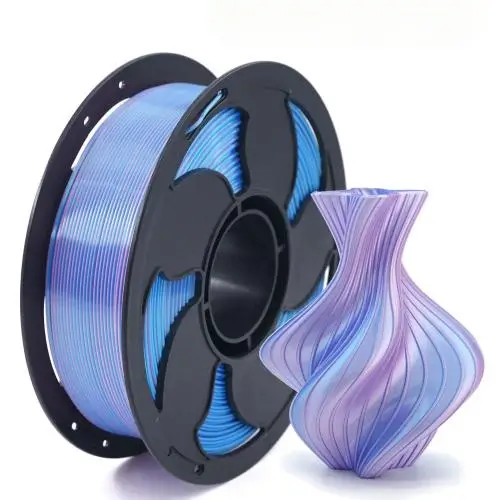
Key Tips for Dual-Color Printing
- Raise purge volumes: Silk pigments are dense and saturated. To prevent “color bleed” during transitions, set your purge volumes 30–50% higher than default.
- Expect grip: The “slick” surface of silk PLA can cause it to slip under the drive gears of the extruder. Ensure your tension is calibrated to avoid grinding the filament.
- Watch the spool: Silk is smooth enough to slip and cross itself. So you need to clip the free end whenever spool leaves the machine.
- Keep it dry: In multi-material setups, filament often sits in the tubes longer. Keep your dry boxes active, as damp silk will ruin a 20-hour multi-color print with fine hair-like strings.
Cost accounting note: Purge waste in dual-color printing can reach 15–30% of material usage — include in quoting.
Does Silk PLA Need Special Hardware?
A common misconception is that silk PLA requires specialized hardware. Fortunately, for most businesses, this is not the case.
- Nozzles: You do not need hardened steel. Silk PLA is non-abrasive. Standard brass nozzles are actually preferred as they have better thermal conductivity.
- Enclosures: Not needed. Like all PLA 3D printer filament, silk performs best in an open environment with plenty of part-cooling fan power.
- Extruders: Ensure your extruder gears are clean. Because silk is slightly softer, any debris in the gear teeth can cause slipping.
Only recommendations: keep extruder gears clean and filament dry.
Procurement Guide: Material Selection for 3D Printing Projects
For distributors and manufacturing businesses, the choice between PLA vs. Silk PLA is a strategic one.
Material Selection Quick Reference
- Standard PLA filament: The “Safety” choice. High strength, low cost, maximum reliability. Best for B2B industrial clients.
- Silk PLA filament: The “Premium” choice. High visual impact, higher price point, requires more skilled labor to tune. Best for B2C retail products.
Supplier Evaluation: The Professional Checklist
When sourcing 3D filament in bulk, use the following criteria to evaluate your suppliers:
1. Price Stability
Standard PLA is a commodity. You need a supplier with stable pricing for high-volume contracts. Silk PLA prices fluctuate more, but look for a supplier who offers volume discounts to protect your margins on premium product lines.
2. Batch Consistency
Ask your supplier: How do you measure gloss consistency between batches? A slight change in the additive mix can mean that a product printed in January won’t match a product printed in March. For standard PLA filament, focus on diameter tolerance (±0.03mm or better).
3. Supply Capacity
Regular PLA enjoys strong market demand, and established suppliers typically maintain bulk inventory. During evaluation, confirm whether their stock depth and replenishment cycles can match the project’s production schedule.
Silk PLA, due to its diverse formulations and fragmented demand, may not be available as long-term stock from all suppliers. Advance confirmation of production scheduling lead times is essential to prevent supply interruptions from delaying high-value order deliveries.
4. Technical Support
Does the supplier provide specific “Golden Settings” for their silk PLA? Because every brand uses different plasticizers, a supplier who provides tested profiles for popular machines (like Bambu Lab or Creality) is worth the extra cost.
5. Sample Policy
Never buy a pallet of PLA without testing a sample spool from that specific batch. Verify the “shine” and the layer adhesion before committing to a large-scale project.
Conclusion
In the competitive world of 3D printing, the winner is usually the one who best matches the material to the application.
Standard PLA filament remains the undisputed king of functional production. Its ease of use and structural reliability make it the essential choice for 90% of 3D printing projects. However, for those looking to capture the high-value gift and decor market, silk PLA filament offers a shortcut to a premium finish that standard materials simply cannot match.
For distributors and resellers, maintaining a balanced inventory of both is key. Provide the reliability of PLA filament spools for the engineers, and the brilliance of silk for the designers. By mastering the technical differences and procurement strategies, your business will be well-positioned to lead the market in both quality and profitability.