
PLA and PETG filaments are the two most popular materials in FDM 3D printing. But they are far from the same. Pick the wrong one, and you might find your masterpiece melting in a hot car or snapping under pressure.
This article will delve into the differences between PLA and PETG filaments and provide you with material selection suggestions suitable for different projects.
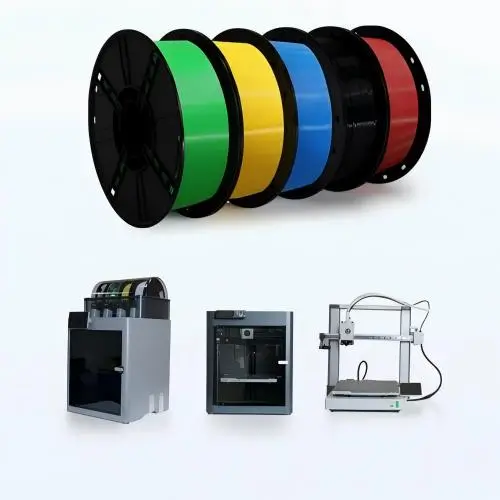
What is PLA Filament?
Polylactic Acid (PLA) is a biodegradable thermoplastic derived from renewable resources (corn starch or sugar cane).
The beauty of PLA is its forgiveness. It asks very little of your printer: no enclosure, no scorching hot bed, no fuss. It has a low melting point, so your printer doesn’t have to work overtime to melt it, making it the go-to for rapid prototyping.
Key Characteristics:
- No heated bed required: Usually, it sticks just fine to blue painter’s tape or a EPI sheet at room temp.
- Minimal warping: Unlike other materials, PLA doesn’t really shrink as it cools, so your corners stay flat.
- Rigidity: It’s very stiff, making it great for parts that shouldn’t bend.
- Eco-friendly: Biodegradable under industrial composting conditions.
- Detail & aesthetics: PLA captures razor-sharp edges and comes in stunning finishes like Silk, Matte, and Glow-in-the-dark.
- High-speed friendly: If you’re running a high-speed printer, PLA is the best choice.
Typical Applications
Figurines, decorative items, prototyping, cosplay helmets, educational projects…
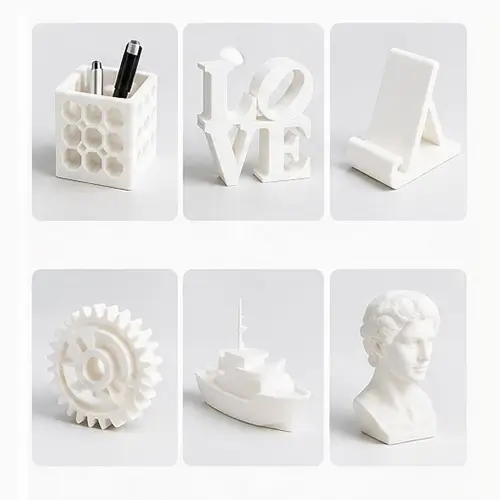
When to Choose PLA Filament?
- Printing decorative items, toys, or large-scale models where ease of printing is a priority.
- Pursue fine details and a smooth surface finish.
- Need high-speed printing.
- Print in a bedroom or office without an enclosure.
What is PETG Filament?
Polyethylene Terephthalate Glycol-modified (PETG) takes the same base plastic as your average water bottle and adds a Glycol twist that makes it perfect for 3D printing.
PETG is the bridge between the ease of PLA and the mechanical strength of ABS. It’s a co-polyester known for being incredibly durable. It’s got a bit of “flex” to it—not like a rubber band, but just enough that it will bend before it snaps.
Features:
- Durability: It can take a drop or a hit much better than PLA.
- Weather resistance: It’s UV-resistant and water-resistant. If you’re printing something for outdoor uses, this is your guy.
- Flexibility: Will not snap like PLA when bent.
- Higher heat resistance: While PLA turns into a noodle in a hot car, PETG stays solid.
- Glossy finish: It naturally has a glass-like, shiny look that looks great on functional parts.
Typical Applications
Functional brackets, outdoor tools, load-bearing structural parts, or even aquarium components.
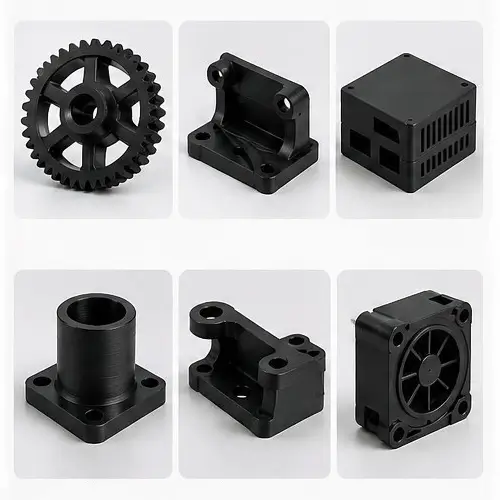
When to Choose PETG Filament?
- The part needs to function. If it’s a hinge, a clip, or a shelf bracket, you need that impact resistance.
- It’s going outside. Garden hose splitters, bird feeders, or outdoor signage need to survive UV rays.
- Print parts need transparency. PETG offers much better light transmission for things like lamp covers or containers.
- You need chemical resistance. PETG is much more resistant to oils and common household chemicals than PLA.
Pro Tip: If you’re going to use PETG, keep a dry box ready. PETG is like a thirsty sponge. If it sits out for a few days in a humid room, it’ll start popping and sizzling at the nozzle, leading to a failed print.
Head-to-Head Comparison: PLA vs. PETG Filament
| Comparison Dimension | PLA | PETG |
|---|---|---|
| Print Difficulty | Easiest to print, great for high-speed printing. | Moderate. Prone to “stringing” and requires more fine-tuning of retraction settings. |
| Strength & Durability | High tensile strength but brittle, poor impact resistance | Excellent impact resistance, good fatigue resistance |
| Thermal Properties | Softens at 50–60°C | Softens at 70–85°C (superior heat resistance) |
| Print Appearance | PLA’s variety of colors (Silk, Matte, Glow-in-the-dark). | Glossy glass-like finish, great for translucent/transparent parts |
| Post-Processing | Easy to sand and paint | Difficult to sand, not suitable for glue bonding |
| Storage & Hygroscopy | Slower moisture absorption | Highly hygroscopic (absorbs water like a sponge) |
| Biodegradable | Industrial compostable | Non-degradable |
Why You Need Both in Your Workshop?
Most seasoned makers keep a healthy stock of both. You use PLA for the “cool stuff” and PETG for the “useful stuff.” This is where the benefit of buying a filament bundle comes in.
Instead of buying one roll and hoping it works for every project, getting a 3D printer filament bundle ensures you have the right tool for the job at a moment’s notice. Plus, let’s face it—we all love saving money. Buying in bulk or mixed-material bundles is the most cost-effective way to avoid trying to print a structural car part out of Silk PLA (spoiler: it won’t end well).
Looking to stock up? Check out our Filament Bundle to grab a mix of both!
Manufacturer’s Perspective: Does Quality Really Matter?
When discussing the PLA vs. PETG filament debate, we have to talk about quality control. Why? Because a 0.05mm variance in diameter can be the difference between a perfect print and a clogged nozzle.
The +/- 0.02mm Rule
At our facility, we obsess over consistency. High-quality 3D printer filament should maintain a diameter tolerance of +/- 0.02mm. If the filament gets too thick, it jams. If it gets too thin, you get “under-extrusion,” which leaves ugly gaps in your print.
Pure Raw Materials
Not all PLA is “pure” PLA. Some manufacturers add cheap fillers to lower costs. These fillers can have different melting points, causing inconsistent flow and mysterious clogs. Whether you are choosing PLA filament or PETG filament, always look for brands that prioritize high-quality raw materials. It saves you hours of troubleshooting in the long run.
Conclusion
So, in the battle of PLA vs. PETG filament, who wins?
The answer is: It depends on what you’re making.
- Choose PLA if you want a stress-free printing experience, beautiful colors, and high-detail models for your shelf.
- Choose PETG if you need a part that can survive the “real world”—heat, sun, and physical stress.
My final recommendation? Start with PLA to learn the ropes of your machine. Once you’re comfortable, move to PETG for your functional projects. Having both on your shelf makes you a more versatile maker.
Ready to start your next project? Get a quote of our high-quality PLA filament and PETG filament today, or save more with a custom filament bundle!
FAQs
In terms of “tensile strength”, PLA is actually often stronger. However, PLA is brittle and it snaps like a dry twig. PETG filament is tougher — it has better impact resistance and will bend or deform before it actually breaks. For most real-world uses, PETG is considered the “stronger” functional choice.
For PLA filament, a heated bed is optional but recommended (around 50-60°C). For PETG filament, a heated bed is almost always a requirement (around 70-85°C) to prevent the edges from curling and lifting.
This is usually due to two things: heat and moisture. PETG loves to soak up water from the air. If it’s “wet,” it will string like crazy. Also, try lowering your print temperature by 5 degrees or increasing your retraction speed.
Technically, yes, if you have a dual-extruder printer, but they don’t bond together very well. They are chemically different enough that they won’t “stick” to each other effectively. It’s better to stick to one material per part.
While PETG is much safer than materials like ABS (which releases toxic fumes), it’s always a good idea to have some airflow in your 3D printing room.
PETG filament is better for outdoors. It handles UV radiation from the sun and temperature fluctuations much better than PLA, which will degrade and warp over time when exposed to the elements.