
PLA filament serves as the primary choice for 3D printing projects because of its ease of use and eco-friendly origins. However, as professional demands grow, the Plus version has emerged as a tougher, faster alternative designed to overcome the brittleness and low heat resistance of the original.
If you’re managing a project, you likely wonder if the “plus” is a real performance upgrade or just a marketing tactic to sell a pricier filament bundle. This guide breaks down the specs of each filament to help you decide which material truly earns a spot in your workflow.
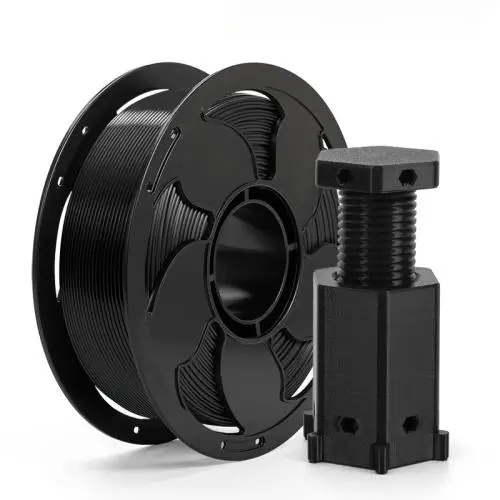
What is PLA+ Filament?
Standard PLA is a bioplastic made from renewable resources like cornstarch or sugarcane. It’s widely considered the “easy mode” of 3D printing because it’s forgiving and user-friendly.
However, standard PLA is brittle, prone to snapping under pressure, and has a very low tolerance for heat.
That’s where PLA+ filament (also known as Pro PLA or PLA Plus) steps in. It isn’t a single, universal formula; instead, each manufacturer mixes in their own proprietart additive blends of modifiers and stabilizers to beef up the material’s physical properties.
In a word, it uses the same familiar base, but it’s specifically engineered to work harder and last longer.
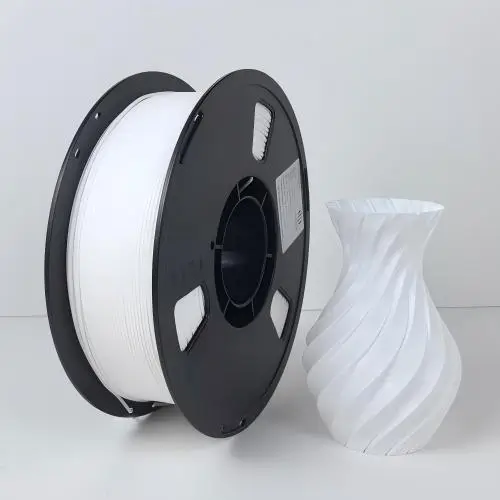
PLA vs. PLA+ Filament
When choosing 3D printing materials, users often find themselves confused between PLA and PLA+. Although the two appear similar, they exhibit meaningful differences in composition, performance, and intended applications.
PLA vs. PLA+ Key Parameter Overview
For a quick reference, the following table summarizes the visual comparison of the two in terms of key performance indicators.
| Feature | Standard PLA Filament | PLA+ Filament |
|---|---|---|
| Durability | Brittle; snaps under high tension | Tough; bends before it breaks |
| Impact Resistance | Low (shatters easily) | High (absorbs shock) |
| Surface Finish | High Gloss / Shiny | Semi-Matte / Satin / Smooth |
| Print Temperature | 190°C – 210°C | 210°C – 230°C |
| Heat Resistance | Low (~55°C) | Higher (~60-65°C) |
| Print Speed | Standard (up to 60-100mm/s) | High-Speed (150mm/s+) |
| Dimensional Accuracy | Good, but prone to minor shrinkage | Excellent; very stable |
| Ease of Use | Extremely easy | Even easier; less prone to clogs |
| Post-Processing | Difficult to sand (melts easily) | Easier to sand and drill |
| Typical Cost | Budget-friendly | Premium |
| Best For | Visual models & rapid prototyping | Functional parts |
The Core Differences Between PLA and PLA+
1. Strength, Durability, and Flexibility
Standard PLA behaves quite rigid before the force reaches the critical point. But once it exceeds the threshold, it will suddenly break and shatter into multiple pieces. This brittleness is its biggest weakness in functional manufacturing.
In contrast, PLA improves the material’s elongation at break by adding toughening modifiers. In simple terms, it can withstand greater deformation before breaking. If you’re printing a clip, a bracket, or a mechanical housing for a research project, PLA+ can absorb the impact energy that standard PLA simply cannot withstand.
2. Surface Texture and Appearance
Both materials can achieve good visual effects, but they have completely different styles. Standard PLA usually has a higher gloss, presenting a “plastic feel” similar to injection molded parts, and is suitable for appearance display models that require a glossy effect.
PLA+ tends to have a semi-matte or satin texture. Because the additives help the layers blend better, the layer lines are often less visible on PLA+ printer pieces. For the mass production of products for end consumers in print farms, PLA+, a more “advanced” touch and visual apperance often becomes an important bonus to affect the purchase decision.
3. Ease of Printing
The standard PLA is renowned for its “user-friendly” feature. However, during long-term printing, it has a hidden danger that is often overlooked – heat creep. When insufficient cooling, material softening expansion in advance in the extruder, lead to extrusion resistance even plug in.
Most PLA+ formulations reduce this risk by adjusting the melting temperature and flow characteristics. Its wider processing window means that it is more fault-tolerant to the heat dissipation conditions of the printer, and the extrusion state is more stable even in the long cycle of printing for tens of hours. For printing farms that require unmanned operation, this improvement in reliability cannot be underestimated.
4. Print Speed Limit
With modern machines reaching incredible speeds, the material often becomes the bottleneck. Standard PLA often struggle to melt fast enough to keep up, leading to under-extrusion, poor interlayer bonding, and surface defects such as stringing or void formation.
In contrast, PLA+ filament is often designed with better thermal conductivity, allowing it to melt faster and cool more predictably. Therefore, when using the Klipper firmware or high-speed CoreXY models, PLA+ can better match printing speeds above 150mm/s while maintaining good layer adhesion and surface quality.
For the parameter settings and actual performance of PLA printing speed, please refer to “PLA Print Speed: What is the Best Speed for Your 3D Prints?“
Other Notable Differences
5. Dimensional Accuracy
Standard PLA is known for low warping. However, the improvements in fluidity optimization and cooling consistency of PLA+ enable it to exhibit better dimensional retention ability in large-scale printing.
If you need to print components that need to fit together (such as gear sets, snap-fit connectors, assembly models), PLA+ tends to offer a more predictable fit right off the bed. As a result, it can reduce the trial-and-error cost of repeatedly adjusting compensation values.
6. Post-Processing
If you want to sand, primer and color your printed parts, the advantages of PLA+ are remarkable. Ordinary PLA has a lower melting point, making it very troublesome to sand. The friction of sandpaper generates heat, causing the plastic to “stick” and bubble off.
The modified formula of PLA+ not only makes the sanding process smoother, but also has better adhesion to various coatings and adhesives on its surface. If you often create models or prototypes that require fine painting, this difference will directly affect the efficiency of your workflow.
7. Heat Resistance
The glass transition temp of standard PLA is about 55°C. Beyond this temperature, it will start to soften and deform. Most PLA+ variants raise this indicator to 60-65°C.
A mere 5-10 °C increase may seem trivial, but it can be decisive in real engineering scenarios. For instance, when placed next to a running motor, in a sunlit car interior, or inside a chassis close to heating elements, standard PLA parts may undergo irreversible deformation after a single use. The additional heat resistance provided by PLA+ enables it to have higher engineering usability in these “micro-heat environments”.
8. Costs
The price gap between standard PLA and PLA+ is usually within 10% to 20%, which is roughly $2 to $5 more per kilogram. However, a simple comparison of unit prices does not reflect the true total cost of ownership.
Standard PLA is undoubtedly the economical choice for basic prototyping. However, PLA plus offers better mechanical strength thanks to specialized impact modifiers. Furthermore, its superior flow and tighter diameter tolerances make it ideal for high-speed, long-duration printing.
The reduction in the clogging rate means less waste and manual intervention, and a higher printing success rate means less rework – these hidden cost savings often far exceed the price difference of just a few dollars.
When to Choose Standard PLA Filament?
Standard PLA remains a top choice for projects where cost-efficiency and surface finish are more important than impact resistance.
- Education: Ideal for classrooms and student projects that require a safe, easy-to-print material.
- Early-Stage Prototyping: Perfect for rapid “form and fit” testing. Its low cost allows for multiple iterations without wasting expensive engineering-grade materials.
- Detailed Aesthetics: Provides sharper detail reproduction and a wider variety of colors and finishes (like matte or silk) for figurines and decorative models.
When to Choose PLA+ Filament?
Reach for the PLA+ filament when the stakes are higher:
- Print Farms: The increased reliability and reduced clog rate mean less downtime. Less downtime equals more profit.
- Functional Testing: If the part needs to be bolted, dropped, or clicked into place.
- Research & Development: When you need a material that mimics the properties of injection-molded plastics more closely than hobby-grade PLA.
- High-Speed Printing: If you’ve invested in the latest high-speed 3D printers, don’t bottleneck them with cheap filament.
Alternatives to PLA+ Filament
Sometimes, even the “Plus” isn’t enough. If your project has specific environmental demands, you might look elsewhere.
ABS (Acrylonitrile Butadiene Styrene)
ABS is much more heat-resistant and tougher than PLA+. However, it smells unpleasant odor when printing, requires a heated enclosure, and warps like crazy. In a school or an open office, it’s often a “no-go.” Use ABS only if you truly need the 100℃ heat resistance.
PETG (Polyethylene Terephthalate Glycol)
PETG is more chemically resistant than PLA and survives the outdoors better. It’s almost as easy to print as PLA+ but can be “stringy” and a bit of a pain to dial in. If you plan to print something that will sit in the sun or hold chemicals, PETG is the better move.
Is the PLA Plus Worth It?
For most users printing functional parts, prototypes that will be handled repeatedly, or running a print farm, the answer is yes—PLA+ is worth the modest premium. The price difference, typically $2 to $5 per kilogram, is small enough that a single saved print failure already pays for the upgrade. Add in the reduced clog rate, better dimensional stability for interlocking parts, and a smoother surface finish that requires less sanding, and the total cost of ownership often lands below standard PLA.
The exception is high-volume visual prototyping: if your parts are purely cosmetic, will never bear load, and are printed in large batches on a tight budget, standard PLA still does the job. But for parts that need to survive a drop test, a clamp, or a customer’s hands, the Plus is no longer a luxury—it’s the smarter default.
Looking to scale your production? Check out our latest printer filament specifications.
FAQs
While PLA+ is an “enhanced bioplastic,” ASA is a petroleum-based plastic designed for extreme UV and weather resistance. ASA is much harder to print and requires an enclosure. If your part is going outside for five years, use ASA. If it’s staying indoors but needs to be tough, stick with PLA+.
This is the most common dilemma. Here’s the quick decision matrix:
If the part stays indoors and needs to look good, PLA+. If it goes outdoors or touches chemicals, PETG.
It is industrial compostable. It is not recommended to put in a normal plastic recycling stream.
Yes, PLA+ printing produces almost no odor and its VOC emissions are much lower than those of ABS. However, it is still recommended to print in a well-ventilated room, especially when printing continuously for several hours.