
In the world of additive manufacturing, your choice of 3D printing materials is just as important as the printer itself. Whether you are a hobbyist or an industrial engineer, the material you select dictates the strength, durability, and finish of your final product.
Generally, 3D printing materials are categorized by the technology they use: 3D printing filaments for FDM, liquid resins for SLA, and fine powders for SLS or Metal printing.
1. 3D Printing Filaments for FDM Printing
Fused Deposition Modeling (FDM) is the most popular printing method due to its accessibility and low cost. Here are the most common printing materials for FDM printing.
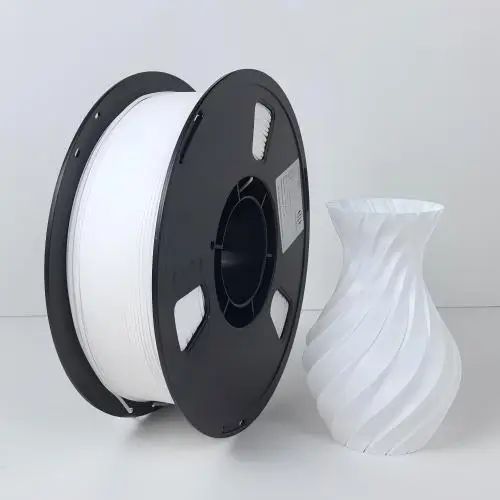
PLA (Polylactic Acid)
PLA is a thermoplastic polymer derived from renewable resources like cornstarch. It is the first choice for almost everyone when starting 3D printing. This is because it is incredibly easy to print, and has minimal warping.
- Low Odor and Non-Toxic: It is biodegradable and releases a sweet, non-toxic aroma when melted.
- PLA is brittle and has a low heat resistance (about 60-70 ℃). So avoid using it for high-stress or high-heat parts.
- Best for: Visual models, rapid prototypes, and educational projects.
Learn more about PLA filament for 3D printing: The Basics of PLA Filament for 3D Printing.
PETG (Polyethylene Terephthalate Glycol)
PETG is the perfect middle ground between PLA and ABS. It combines the ease of use of PLA with the functional strength of ABS.
- Key Features: It is highly impact-resistant, waterproof, and chemically stable.
- Best for: Mechanical clips, garden tools, and functional prototypes.
ABS (Acrylonitrile Butadiene Styrene)
ABS is an industrial-grade material with high strength and good heat resistance. It is commonly used to manufacture automotive parts and heavy-duty items. It can be easily post-processed using sandpaper or acetone vapor for a glossy finish.
Due to the need to heat the bed and chamber to prevent warping, the printing process is more difficult than with PLA, and it also releases a strong odor during the printing.
TPU (Thermoplastic Polyurethane)
TPU is a rubber-like material with high elasticity. It can bend, stretch, and absorb shock without breaking. Therefore, it is suitable for objects that need to be bent or compressed, such as phone cases, vibration dampeners, gaskets, and shoe soles.
ASA (Acrylonitrile Styrene Acrylate)
Similar to ABS, ASA has extremely strong UV resistance and weather resistance. While it shares the same strength as ABS, it won’t turn brittle or yellow when exposed to direct sunlight. It is the top choice for automotive exterior parts.
2. Liquid Resins for SLA and MSLA Printing
Resin printing uses light to cure liquid photopolymers. This method is preferred when “micro” detail and “injection-mold” smoothness are required.
- Standard Resins: Offer incredible detail and a smooth surface, perfect for miniatures and aesthetic models.
- Engineering-Grade Resins: Formulated to mimic the properties of ABS or Polypropylene. These are used for functional parts that need to withstand stress.
- Specialized Resins: Includes dental-grade resins for aligners and biocompatible resins for medical applications.
3. Industrial Powders (SLS and MJF)
Powder-based printing is the standard for professional-grade, “support-free” manufacturing.
- Nylon (PA): Extremely tough and wear-resistant. Nylon is used for end-use mechanical assemblies that need to last a lifetime.
- Carbon Fiber Composites: By reinforcing Nylon with carbon fiber, manufacturers create parts that are incredibly stiff and strong while remaining lightweight.
4. Metal 3D Printing Materials
Metal 3D printing is no longer a futuristic concept; it is actively used in aerospace and medicine.
- Stainless Steel (316L): Known for its high corrosion resistance, it is commonly used in industrial tools and jewelry.
- Titanium (Ti64): It is widely used in aerospace and medical implants due to its light weight, good biocompatibility and extremely high strength.
- Aluminum (AlSi10Mg): Used for lightweight parts that require excellent thermal conductivity, such as heat sinks.
Future Trends of 3D Printing Material
The future of 3D printing materials is moving away from simple plastics toward high-performance, eco-friendly, and “smart” materials.
- High-Performance Polymers: Materials like PEEK and PEI (Ultem) are now being used to replace metal parts in extreme heat environments.
- Sustainable Materials: There is a massive shift toward recycled filaments and bio-composites made from wood fibers or coffee grounds.
- 4D Printing & Smart Materials: 4D printing adds the dimension of time, where a printed object changes shape or property in response to heat or water.
Conclusion: Which Material Should You Choose?
Choosing the right material depends on your project goals:
- For Beginners: Stick with PLA printing filament. It’s affordable and reliable.
- For Mechanical Parts: Go with PETG or Nylon for better durability.
- For Outdoor Use: ASA is your best bet.
- For High Detail: Choose Resin.
By understanding the unique properties of these materials, you can unlock the full potential of your 3D printer and bring your most complex ideas to life.