
Choosing the right filament is essential for achieving consistent quality and efficiency in 3D printing production. Among the most popular materials, PLA filament is widely used because it is affordable, easy to print, and suitable for a wide range of applications.
However, many businesses and print farms need stronger materials for functional parts and durable products. This is where tough PLA version becomes a valuable alternative, offering better impact resistance while maintaining the simple printing experience of standard PLA.
In this PLA vs. Tough PLA comparison, we will explore the key differences in printing performance, strength, temperature resistance, cost, and applications. By the end, you’ll know exactly which one deserves a spot on your spool holder.
PLA vs. Tough PLA: Key Differences at a Glance
| Property | PLA Filament | Tough PLA Filament |
|---|---|---|
| Material Type | Standard PLA | Modified PLA blend |
| Printing Difficulty | Very easy | Easy |
| Nozzle Temperature | 190–220°C | 200–230°C |
| Bed Temperature | 50–60°C | 50–70°C |
| Enclosure Required | No | No |
| Cooling | High cooling recommended | High cooling recommended |
| Impact Resistance | Moderate (Brittle) | Higher (Durable) |
| Heat Resistance | Lower | Improved |
| Cost | Budget-Friendly | Premium |
| Best Use | Models and prototypes | Functional parts and durable products |
The main difference in PLA vs. Tough PLA is not printability but performance. Both materials are easy to use, but tough PLA provides better mechanical properties.
What is PLA Filament?
PLA, or Polylactic Acid, is one of the most popular materials used in 3D printing. It’s made from fermented plant starch (usually corn or sugarcane), which means it doesn’t smell like a burning plastic factory when you print it. Instead, it smells a bit like sweet waffles.
Standard PLA filament is famous for being incredibly easy to use. It doesn’t warp much, it sticks to the bed like glue, and it captures fine details beautifully. For most hobbyists and businesses doing rapid prototyping, it is the go-to choice.
Typical applications include:
- Concept Models: Seeing a design in 3D for the first time.
- Decorative Items: Vases, figurines, and “knick-knacks.”
- Education: Perfect for schools because it’s non-toxic and easy to handle.
- Form-Fit Testing: Checking if a lid fits a jar before moving to expensive materials.
However, standard PLA filament has limitations. It’s brittle. If you drop a PLA part on a concrete floor, there’s a good chance it will shatter like a ceramic plate. It also hates heat; leave a PLA part in a hot car in July, and you’ll come back to a plastic puddle.
To master the fundamentals first, read our guide on the The Basics of PLA Filament for 3D Printing.
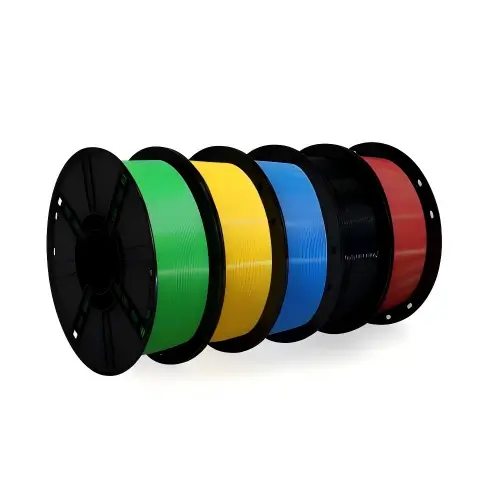
What is Tough PLA Filament?
Tough PLA is essentially a modified PLA blend. Manufacturers take the base Polylactic Acid and “dope” it with impact modifiers and other polymers (like PBT). The goal isn’t necessarily to make it harder, but to make it tougher.
It retains the “easy-to-print” nature of PLA filament but adds the mechanical durability usually associated with ABS (Acrylonitrile Butadiene Styrene).
Why do businesses love it?
- High Impact Resistance: It can take a hit without cracking.
- Reduced Brittleness: It bends slightly before it breaks.
- Better Durability: It stands up to repeated handling and mechanical stress.
Printing Performance: Is One Harder to Tame?
PLA Printing Performance
Printing with standard PLA filament is very smooth. You don’t need a heated chamber, and you barely even need a heated bed (tough it helps). It has excellent layer adhesion and very low “shrinkage,” which means you parts come out the exact size you intended.
Tough PLA Printing Performance
Tough PLA filament is almost as easy to print as the standard stuff. You might need to bump your nozzle temperature up by 5 or 10 degrees, but that’s about it. It doesn’t have the nasty warping issues of ABS or the moisture sensitivity of Nylon.
For a print farm owner, this is huge. You get “ABS-like” strength without having to upgrade all your printers with enclosures and high-temperature nozzles. It’s a “plug and play” upgrade for your production line.
Strength Comparison: PLA vs. Tough PLA
When we talk about “strength,” we usually mean two things: Tensile Strength (how much weight it can hold) and Impact Resistance (how well it handles a sudden smack).
- Stiffness: Standard PLA is actually very stiff. If you need a part that absolutely won’t bend, standard PLA filament is great. But stiffness is a double-edged sword.
- Toughness: This is where tough PLA filament wins. If you put a PLA part in a vice and tighten it, it will eventually explode into shards. If you do the same with Tough PLA, it will deform, flatten, and eventually tear, but it won’t “shatter.”
In the real world, “shatter” is bad. If you’re building a housing for a handheld tool or a bracket for a machine, you want a material that can absorb vibration and accidental drops. That’s why Tough PLA is the king of functional prototypes.
Heat Resistance Comparison
Neither of these materials is going to win a prize for heat resistance.
Standard PLA starts to soften (the “Glass Transition Temperature”) around 55–60°C (131–140°F). If you print a coffee cup sleeve out of PLA, it might start to sag while you’re drinking your latte.
Tough PLA is slightly better, often staying stable up to about 65–70°C depending on the blend, but it’s still not a “high-temp” plastic. If your part needs to live inside an engine bay or under the scorching desert sun, you might need to look toward PETG, ASA, or Polycarbonate.
However, for most indoor industrial environments or office-use products, tough PLA offers that extra bit of “thermal headroom” that prevents your parts from warping on a warm afternoon.
Cost Considerations
Material cost is a major factor for companies purchasing large quantities of 3D printer filament.
The procurement cost of PLA is lower. Because its sources are diverse, and the low failure rate of printing, the maintenance and waste costs are also relatively low.
Tough PLA filament comes with a premium. You’re paying for the R&D and the specialized additives that give it those enhanced properties.
If a standard PLA jig breaks on the assembly line and stops production for an hour, you’ve lost way more money than the $15 you saved on the filament spool. For functional parts, the durability of Tough PLA actually makes it the cheaper option in the long run because you won’t be re-printing broken parts every week.
The real cost comparison should include durability and replacement frequency, not only filament price.
Conclusion
The choice comes down to the end-use environment. PLA is the right call for visual models and cost-driven projects. But when your ideas need to go to work—when they need to be stepped on, dropped, bolted, and put through the ringer—tough PLA filament is a better choice. It takes the stress out of 3D printing by giving you parts you can actually trust.
Need a custom material recommendation? Contact our team today for a quick consultation and let’s get your production line moving!