
Introduction
Globally, we use about five trillion single-use plastic bags each year. We have all witnessed the unfortunate results – plastic bags getting entangled in trees, blocking our waterways, or lying in landfills for centuries. It’s a massive problem, and for any business, being part of that problem is no longer an option.
Faced with these serious plastic crisis, what are the practical alternatives? Is there a way to offer convenience without the centuries-long environmental bill?
There is, and it’s gaining momentum. Compostable bags are emerging as a truly eco-friendly and promising option. But it’s not just about slapping a “green” label on something. There are real benefits that can help the planet and your brand’s reputation.
What are Compostable Bags?
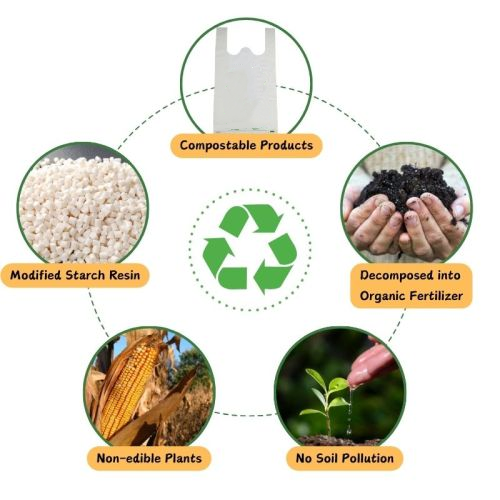
Unlike traditional plastic made from petroleum, these bags are created from renewable, plant-based materials. Think things like corn starch, sugarcane, PLA (Polylactic Acid, derived from plant sugars), and PBAT (a flexible material that helps the bag break down).
In the right environment (composting), these bags break down completely into water, carbon dioxide, and biomass. There’s no toxic residue, and no tiny plastic fragments.

Compostable vs. Biodegradable Bags
The term “biodegradable” is pretty vague. It simply means that something will eventually break down with the help of microorganisms. But it doesn’t specify how long it will take (it could be decades!) or what it will leave behind. Some biodegradable plastics can still leave behind metals or other undesirable residues.
“Compostable,” on the other hand, is a regulated and certified term. For a bag to be labeled as compostable, it must meet strict standards. It has to break down into natural elements within a specific timeframe (usually 90-180 days) in a composting facility, leaving nothing harmful behind. It’s the gold standard for sustainable packaging.
7 Environmental Benefits of Choosing Compostable Bags
1. Reduce Plastic Pollution and the Burden on Landfills
Traditional plastic bags take hundreds of years to decompose. They clog rivers, endanger wild animals and just pile up. However, compostable bags can be completely decomposed within a few months in industrial composting facilities. This dramatically cuts down on the amount of permanent waste we’re sending to landfills and letting loose in the environment.
2. Reduce Reliance on Fossil Fuels
Traditional plastics are made from non-renewable petroleum and natural gas. We have to drill for them, refine them—it’s an energy-intensive process that we can’t sustain forever. Compostable bags primarily come from annually renewable plants. By using plants, we reduce our dependence on finite fossil fuels right from the start.
3. Reduce Carbon Footprint during the Decomposition Process
Plants absorb carbon dioxide from the atmosphere as they grow. When compostable bags decompose, the amount of carbon dioxide they release is roughly equal to the amount absorbed by plants, forming a nearly carbon-neutral cycle. In contrast, the production and incineration of plastics pump a large amount of greenhouse gases into the atmosphere.
4. Transformed into Nutrient-Rich Compost to Nourish the Soil
Under the right conditions, compostable bags will turn into humus, a nutrient-rich soil conditioner. This kind of compost can improve soil structure, water retention capacity and fertility. In addition, it reduces the need for chemical fertilizers and creates a beautiful “cradle-to-cradle” system where waste from one product becomes food for the next.
5. No Microplastics Left Behind
Traditional plastics will degrade into tiny plastic particles (microplastics), polluting water sources and soil and entering the food chain. Compostable bags completely decompose into natural substances and do not cause persistent microplastic pollution.
6. Support the Circular Economy
The use of compostable bags, especially for collecting organic waste like food scraps, is a game-changer for creating a circular economy. It allows businesses and households to easily divert organic waste away from landfills. These wastes, along with bags, are transformed into valuable compost and then used to grow new foods, forming a circular economic model.
7. Enhance Environmental Awareness and Promote Green Innovation
The behavior of consumers choosing compostable bags sends a strong signal to the market that there is a demand for sustainable products. This has encouraged more companies to invest in the research and development of environmental protection technologies, promoting the entire industry to develop in a greener direction. It’s a choice that reflects well on your brand.
Proper Disposal and Best Practices
Condition: Composting Environment
Biodegradable compostable bags need to send in a compost bin or a commercial composting facility, not the recycling bin and definitely not the landfill. If a compostable bag ends up in a landfill, it gets buried without oxygen and can’t break down properly. It might even release methane, a potent greenhouse gas. And putting them in plastic recycling stream contaminates the batch, as they are designed to break down, not be melted and remolded.
How to Identify Genuine Compostable Bags
So, how do you know you’re getting the real deal? Look for certification marks from reputable organizations.
- ASTM D6400 certified by BPI (Biodegradable Products Institute) in the United States
- AS 5810 and AS 4736 certified by ABA (Australasian Bioplastics Association) in Australia
- OK Compost HOME/INDUSTRIAL (TÜV AUSTRIA) in the EU


Conclusion
To sum it up, compostable plastic bags offer real, measurable environmental benefits. They reduce pollution and carbon dioxide, cut our reliance on fossil fuels, nourish the soil and support the circular economy.
But realizing these benefits is a team effort. It depends on businesses like yours choosing certified products and on all of us disposing of them correctly. We encourage you to check your local waste management policies to see what commercial composting options are available.
By choosing certified compostable bags for your business, you’re not just buying a product; you’re taking a concrete and meaningful step toward a cleaner, more sustainable future.