
Poly mailers have long been a common packaging solution for e-commerce and shipping businesses. However, the reliance on these single-use items has contributed significantly to “white pollution” and poses a serious ecological threat.
Luckily, a solution is at hand. Compostable mailer bags are rising in popularity as a powerful alternative designed to eliminate plastic waste and help companies meet their sustainability goals.
But how do you go about sourcing the best compostable mailer bags for your brand? This post offers a complete guide to help you navigate the process.
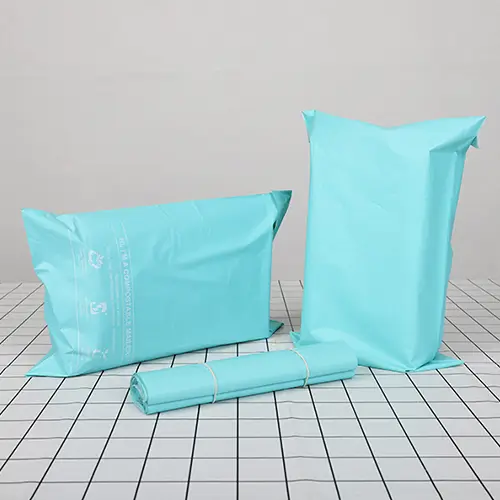
What are Compostable Mailer Bags?
Unlike traditional poly mailers made from virgin plastic (petroleum-based materials), compostable mailer bags are usually a blend of bio-based materials. We are talking about things like cornstarch, PLA (Polylactic acid), and PBAT (Polybutylene adipate terephthalate).
PBAT is a biodegradable copolymer that gives the bag its flexibility so it doesn’t snap like a dry twig. When these compostable shipping bags are placed in the right environment, they break down into carbon dioxide, water, and biomass—leaving behind no microplastics and no guilt.
There is a massive difference between “biodegradable” and “compostable.” Biodegradable just means an item will breaks down eventually, though it could take decades. Compostable means it breaks down into organic matter within a specific timeframe (usually 90-180 days). When sourcing, you need to look strictly for compostable options.
How to Choose the Best Compostable Mailer Bags?
When looking for some sustainable mailer bags for your brand, how do you choose a reliable supplier? Here are some key factors to consider.
1. Verify the Certifications
Certifications are the most critical proof of validity for compostable products. Honestly, if a supplier can’t show you valid certificates, you risk buying “greenwashed” products—plastic items with a fancy eco-friendly label.
You need to look for the “drivers’ licenses” of the composting world. These are standard certifications proving the mailer bags will actually break down.
| Certification | Region Relevance | What it Means |
| TUV Austrial OK Compost | Europe / Global | Industrial composting |
| BPI (Biodegradable Products Institute) ASTM D6400 | North America | Verifies compostability in municipal facilities |
| ABA (Australasian Bioplastics) AS 4736 | Australia / New Zealand | Commercial composting |
| EN 13432 | Europe | The technical standard for compostability |
2. Durability and Functional Requirements
A compostable bag for e-commerce shipping is useless if it rips open and your customer’s garment falls out in the back of a delivery truck. Therefore, durability is a crucial factor.
Thickness Matters
For compostable plastic bags, thickness is measured in microns (µm). The standard thickness for mailers ranges from 40 to 60 microns (about 1.6 to 2.4 mil). Finding the optimal thickness helps shipping costs and material usage low.
- Clothing: 30-40 microns is usually sufficient.
- Heavy or Sharp Items: If shipping shoe boxes or heavier items, bump the thickness up to 50 or 60 microns.
Water Resistance
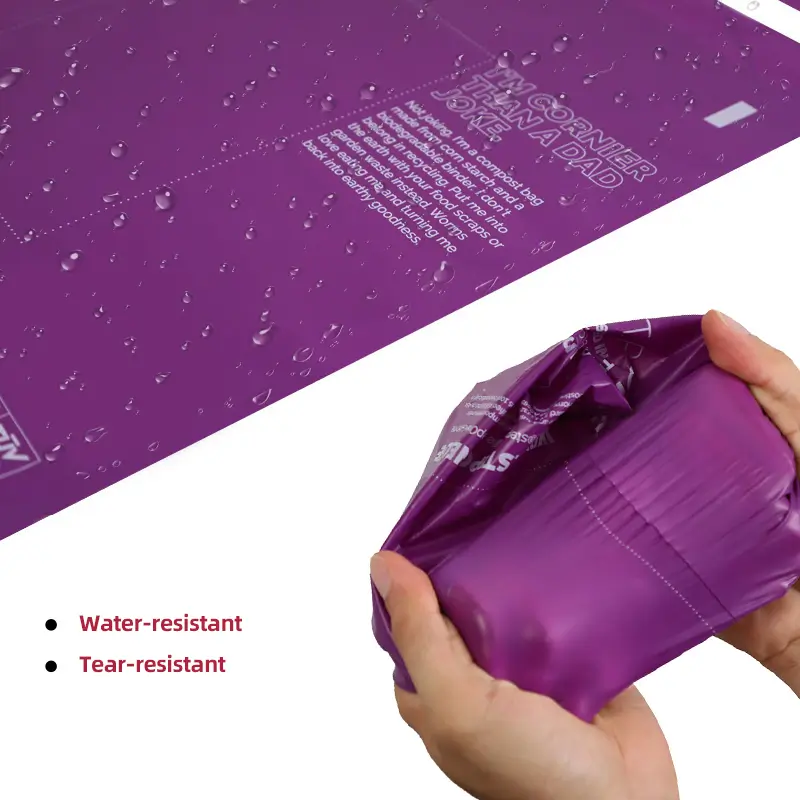
High-quality compostable mailer bags are water-resistant. They protect contents from rain, snow, and splashes just as well as plastic. However, they are hydrophilic over time. This means if you leave them submerged in a puddle for days, they will start to break down. For a standard delivery route, however, they are perfectly safe.
Adhesion: The Peel-and-Seal Strip
There is nothing worse than packing an order only to find the strip barely sticks. You want a hot-melt adhesive that bonds instantly.
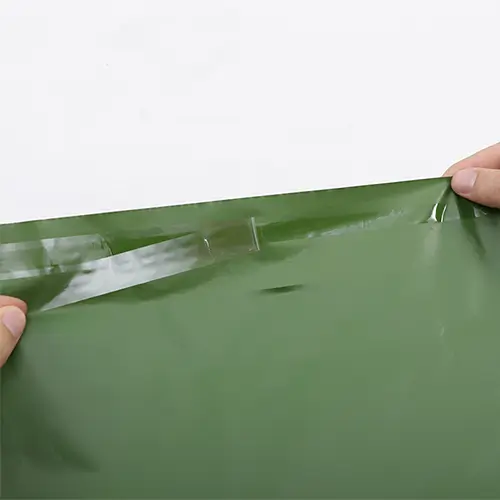
When sourcing, ask your supplier about the “destructive bond.” This means that if someone tries to open the bag, they have to tear the material itself, providing clear evidence of tampering. Also, ensure the peel-off strip (release liner) is easy to remove creating static cling issues.
Double Adhesive Strip & Die-Cut Handles
Compostable mailers with a double adhesive strip are a game-changer. This feature allows the customer to open the bag, decide the item isn’t right, and use the same bag to ship it back to you. It cuts waste in half, making it a massive win for sustainability.
In addition, consider a die-cut handle. If you have a brick-and-mortar store or offer local pickup, a handle transforms the mailer into a carrier bag, adding a premium touch.
3. Branding and Customization
You’re paying for these compostable mailer bags, so they should serve as a billboard for your brand. Customization builds brand identity, but because these bags are organic, there are some rules to follow.
Ink Safety and Eco-Friendly Printing
Using standard petroleum inks on a compostable bag defeats the purpose. If the bag rots but the ink posions the soil, the process has failed. Ensure your supplier uses soy-based or water-based inks. These are non-toxic and break down harmlessly.
Color Printing and Design Limitations
Compostable shipping bags don’t hold ink quite as sharply as glossy plastic. The material is slightly more porous and typically has a matte finish.
- Colors: You can print in almost any Pantone color, but expect the saturation to be slightly lower. This gives the bag a natural, earthy look, which helps sell the “eco-friendly” vibe.
- Shelf Appeal: Most brands opt for a simple design—such as a logo and some witty text.
- Background Color: The natural color of the resin is usually a creamy off-while or a semi-transparent frost. You can dye the bag black, pink, or any other color, but be aware that heavy dye loads can sometimes affect the composting speed.
4. Cost Analysis
Compostable mailer bags are more expensive than plastic. Typically, you are looking at a cost increase of 1.5x to 3x compared to cheap poly mailers. However, you must look at the Return on Investment (ROI).
Customers are willing to pay more for sustainability. Studies show that a large segment of Gen Z and Millennials actively choose brands on their packaging.
Think of the extra cost not as a packaging expense, but as a marketing expense. You are buying customer loyalty. Plus, in many regions, governments are starting to tax single-use plastics. Investing in compostable bags now is a way of future-proofing your business.
5. Shelf Life
Plastic lasts forever; you can leave poly mailers in a warehouse for ten years, and they’ll be fine.
However, compostable mailer bags are like a loaf of bread. They are organic and designed to break down. Generally, these bags have a shelf life of about 10-12 months. After that, the material might start to lose some strength.
Storage Tips
- Keep them cool: Heat accelerates the breakdown.
- Keep them dry: Humidity is the enemy.
- Keep them dark: UV light can weaken the polymer chains.
If you are a distributor, practice “First-In, First-Out” (FIFO) inventory management rigorously. Don’t overstock a three-year supply, or you’ll end up with a warehouse full of dust.
Customer Education
If a compostable bag goes to a landfill, it doesn’t compost properly. Instead, it creats methane, which is harmful to the environment. Therefore, customer education is essential.
Printed Instructions and QR Codes
Don’t be subtle. Print large text on the bag: “I AM NOT PLASTIC.”
Use a QR code that links to a video showing customers how to compost it. Show them how to cut it up and put it in their home compost bin or green waste bin. Make it fun. “Plant me!” is a common phrase that works well.
Covering Labels
If you slap a giant plastic shipping label on a compostable bag, the bag becomes contaminated.
Ideally, you should source compostable thermal labels. If that’s too expensive, instruct your customers to cut the shipping label off before composting. It’s a small step, but it makes a big difference.
Conclusion
Sourcing compostable mailer bags for your brand isn’t just about swapping one product for another. It’s a statement telling your customers that you care about the planet just as much as you care about profit.
You have to verify certifications, monitor shelf life, and you might pay a few cents more per unit. But the payoff is huge. You gain a brand image that screams “responsibility.”
So, go ahead and embrace these sustainable options for your brand.