
You’re facing the shelf, where “compostable” and “recycled plastic” bags sit side by side. You might be wondering: Which is the better choice? What really sets them apart?
That’s exactly what we’re here to unpack. This article breaks down how each bag is made, where it shines, and where it falls short. So you can cut through the confusion and make a truly informed choice for your own sustainable waste management.
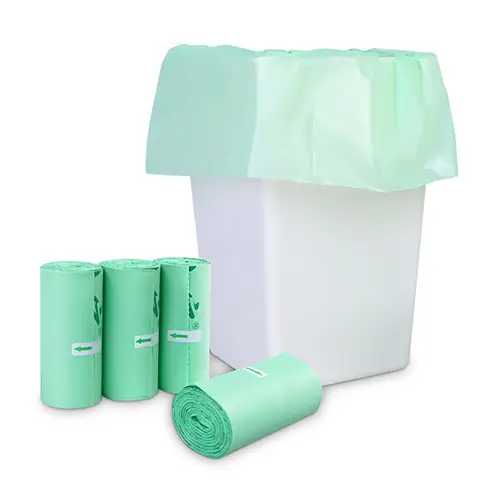
Recycled Plastic Trash Bags
Its mission is pragmatic: to give existing plastic is second, third, of forth life. These bags are made from post-consumer recycled (PCR) materials, which are often from things like used plastic bottles, containers, and even old plastic bags. Bags can contain different percentages of recycled plastic (e.g., 35%, 70%, 80%, 100%).
Think of it as a diversion tactic. It takes plastic that’s already in the system and prevents it from becoming virgin material extracted from the ground. It’s not a perfect, circular ending, but it’s a massive step towards a less wasteful linear model.
Why Recycled Plastic Make Sense
- Tackles Existing Waste
From a carbon footprint perspective, recycled plastic is actually a heavyweight champ. Making a bag from recycled polyethylene requires less energy than drilling for oil to make “virgin” plastic. It’s a classic example of the circular economy—keeping materials in the loop as long as possible before they eventually exit.
- Familiar Reliability
They perform just like the traditional plastic bags you’re used to. Strong, reliable and puncture resistant to hold waste for commercial or industrial applications.
Downside of Recycled Plastic Trash Bags
They are still plastic. At the end of their life, a recycled plastic bag containing your trash is going to a landfill. They will sit there for centuries and won’t turn into soil. While you saved energy making it, you aren’t solving the end-of-life crisis. You’re just delaying the inevitable.
Compostable Trash Bags
These bags are usually made from PLA, PBAT and corn starch. You can fill the bag with your food scraps, toss it in the bin, and poof. It finally returns to the earth to nourish the soil for the next harvest.
Degradation Factors
For a compostable bag to work, it needs a specific environment: heat, moisture, and microbes. If your city have a municipal “green bin” program that accepts compostable liners, these bags are a miracle. They facilitate sustainable waste management by keeping food scraps clean and easy to transport to an industrial composting facility.
However, if these bags are sent into a regular landfill, it might cause some harmful effects.
Because landfills are anaerobic environments (meaning there’s no oxygen). When compostable stuff tries to break down without oxygen, it doesn’t turn into soil. It turns into methane. And methane is a greenhouse gas that’s about 25 times more potent than carbon dioxide at trapping heat.
Read more: Using Compostable Trash Bags: A Responsible Guide.
Difference Between Compostable Trash Bags and Recycled Trash Bags
The main differences in the following respects:
1. Texture
Recycled trash bags are manufactured by post-consumer recycled content, so the texture is slightly rough.
In contrast, compostable bags are made from PLA or corn starch polymers, giving the soft texture to them.
2. Durability
Recycled plastic bags are tough, tear-resistant to handle anything.
Compostable bags are designed to break down eventually—sometimes before you want them to. If you put wet coffee grounds or soup remnants in a compostable bag and leave it for three days, you might lift the bag out only to find the bottom has decided to stay in the can.
Compostable materials are breathable, which is good for composting but bad for your kitchen floor. If you use these, you have to take the trash out more often.
3. The Cost of Conscience
I won’t sugarcoat it: compostable trash bags vs. recycled plastic trash bags is also a battle of the wallet.
Recycled bags are generally cheaper. Manufacturing infrastructure for plastic is massive and efficient. Compostable resins are newer, harder to source, and the manufacturing process is finicky. You will pay a “green premium” for compostable options. For a business managing overhead, that 20% to 40% price hike adds up fast.
4. The Source Material
Recycled bags use waste to hold waste. It cleans up the existing mess.
Compostable bags use crops (like corn or sugar cane) to hold waste.
Some critics argue that we shouldn’t be using agricultural land to grow corn for trash bags when we could be growing food. It’s a valid point. However, the counter-argument is that we need to wean ourselves off fossil fuels entirely, and bio-plastics are the stepping stone to doing that.
Which One Should You Buy?
Which one to choose from depends entirely on your local infrastructure and your requirements.
Choose Compostable Bags If:
- You have regular, reliable access to a commercial composting facility.
- You have a serious home compost setup in your backyard.
- You are primarily using them for food scraps and other organic waste.
- You’re okay with a potential trade-off in sheer, bomb-proof durability for the ideal of circularity.
Choose Recycled Plastic Bags If:
- Your city does not have a commercial composting program.
- You need a bag for general, non-compostable trash.
- You need heavy-duty performance. If you’re a restaurant or a construction site, you need the tensile strength of plastic.
- You are on a tight budget. Sustainability shouldn’t bankrupt you. Doing what you can with recycled content is still a win compared to buying virgin plastic.
Sometimes, the most sustainable choice is using a recycled plastic bag for your landfill trash and a compostable one for your food scraps. They can be teammates, not rivals.
The Future of Trash Bags
Innovations are happening right now that are pretty wild. Scientists are working on bags made from seaweed, mushroom mycelium, and even agricultural waste like potato peels. The goal is to create a bag that acts like plastic while you use it, but acts like a leaf when you toss it.
We aren’t quite there yet. The “perfect” bag—one that is cheap, strong, waterproof, and vanishes instantly in a landfill—doesn’t exist.
Conclusion
So, here is the verdict on the showdown of compostable trash bags vs. recycled plastic trash bags.
Think of your trash can as a destination terminal. Where is the train going?
If the train is going to a compost facility, buy the ticket (the bag) that lets you off at that station. Use a certified compostable liner.
If the train is headed to the dump, don’t buy the fancy ticket. It won’t get you anywhere different. Buy the recycled plastic bag. It keeps old plastic out of the ocean and ensures your garbage actually makes it to the curb without exploding on your driveway.
FAQs: The Trash Bags Questions
For home composting, look for bags specifically certified as “OK compost HOME” or “AS 5810”.
Yes. Manufacturing with post-consumer recycled (PCR) plastic typically uses less energy and water, and generates fewer greenhouse gas emissions, compared to producing virgin plastic from raw petroleum.
At recycling facilities, compostable plastic can be mistaken for traditional plastic, ruining batches of otherwise good recyclable material. Always keep compostable bags out of your recycling stream unless explicitly instructed otherwise by your local program.
Biodegradable is a vague term meaning a material will eventually break down, but it could take decades and leave behind toxic residue or microplastics.
Compostable is a specific standard meaning the item will break down into organic soil nutrients in a composting environment. Always look for the “compostable” label, not just “biodegradable.”
Not necessarily. Some “plant-based” bags (Bio-PE) are chemically identical to regular plastic but made from ethanol instead of oil. These are recyclable, but they are not compostable. They will last forever just like regular plastic.
Since recycled plastic bags are made from a mix of various post-consumer plastics (milk jugs, packaging, industrial wrap) that were different colors originally, the resulting resin is usually a murky color. Manufacturers often add black or gray pigment to make the color uniform. Actually, it’s a sign that the bag is genuinely made from recycled content.