
Introduction
In recent years, the global shift toward sustainability has driven businesses and consumers alike to seek eco-friendly alternatives to traditional plastic products. One such innovation is compostable cling wrap—a biodegradable solution designed to reduce environmental impact while maintaining the convenience of conventional plastic wrap.
However, not all compostable films are created equal. With varying materials, certifications, and performance levels, choosing the right product can be challenging—especially for bulk buyers in the food service, retail, or packaging industries. Key questions arise:
- Does the wrap meet international compostability standards (like EN 13432 or ASTM D6400)?
- Can it preserve food effectively with optimal oxygen and moisture barriers?
- Is it durable enough for commercial use while remaining user-friendly?
This guide breaks down the essential factors—from material composition to manufacturer selection—to help you make an informed decision. Whether you’re a restaurant chain, grocery store, or packaging distributor, understanding these criteria ensures you invest in a truly sustainable, high-performance compostable cling wrap.
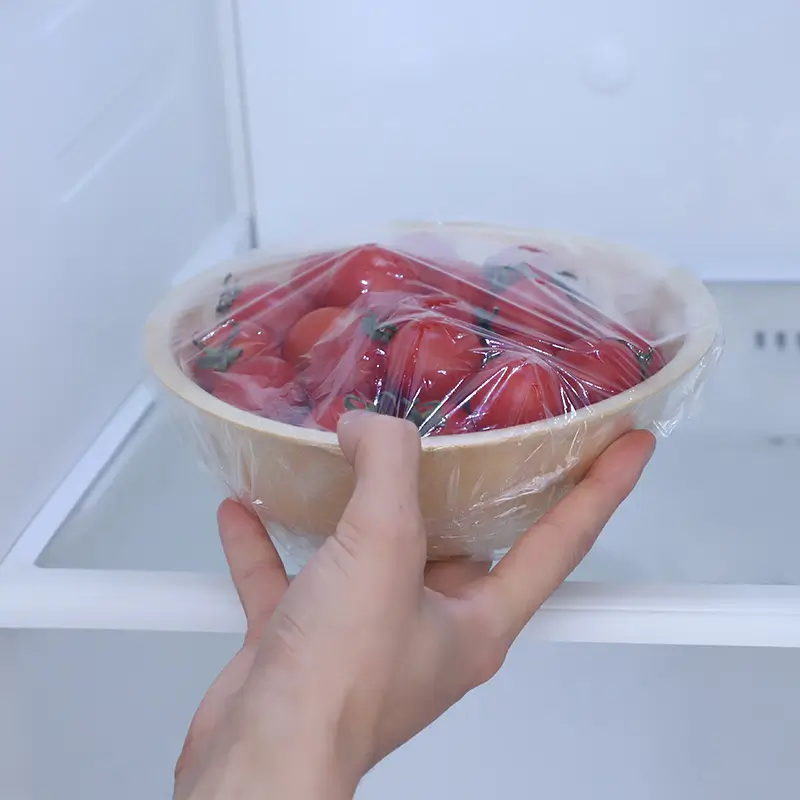
Key Considerations When Choosing Compostable Cling Wrap
1. Material Source
When selecting compostable cling wrap, the material composition is the foundation of its performance, sustainability, and end-of-life behavior. Unlike conventional plastic wraps (made from polyethylene), truly compostable alternatives are derived from biodegradable polymers that break down under specific conditions. Here’s what bulk buyers need to know:
Primary Materials Used in Compostable Cling Wrap
- PLA (Polylactic Acid)
- Source: Made from fermented plant sugars (commonly corn starch or sugarcane).
- Pros: High clarity, rigid structure, and excellent printability.
- Cons: Low flexibility and weaker heat resistance (may become brittle in cold temperatures).
- Best for: Short-term food storage, dry goods, or products where visibility is key.
- PBAT (Polybutylene Adipate Terephthalate)
- Source: Petroleum-based but fully compostable under industrial conditions.
- Pros: Highly flexible, strong cling, and good puncture resistance.
- Cons: Slightly higher cost than PLA; less transparent.
- Best for: Wrapping moist or oily foods (e.g., cheese, meats) due to its elasticity.
- PHA (Polyhydroxyalkanoates)
- Source: Produced by microbial fermentation of plant oils or sugars.
- Pros: Marine-degradable, excellent temperature stability, and biocompatible.
- Cons: Expensive and limited commercial availability.
- Best for: Premium applications where full biodegradability (even in oceans) is required.
- Blended Materials (PLA + PBAT or PLA + Starch)
- Why blend? To balance rigidity (PLA) with elasticity (PBAT) or reduce costs (starch filler).
- Example: A 60% PLA + 40% PBAT blend offers moderate stretch and better compostability.
Red Flags: “Fake” Compostable Materials
- Oxo-degradable plastics: Conventional plastics with additives that fragment (but don’t fully biodegrade). Avoid these—they often fail compostability certifications.
- Uncertified “biodegradable” claims: Demand third-party test reports (e.g., TÜV, BPI) to verify authenticity.
2. Performance
Preservation Effectiveness
To maintain food freshness, the food wrap must provide adequate barriers against oxygen and moisture:
- Oxygen Transmission Rate (OTR)
- Measures how much oxygen passes through the film (cm³/m²·day).
- Ideal range: ≤500 cm³/m²·day for perishable foods (meats, cheeses).
- Low OTR = Slower oxidation, longer shelf life.
- Water Vapor Transmission Rate (WVTR)
- WVTR indicates moisture retention (g/m²·day).
- Ideal range: ≤10 g/m²·day for high-moisture foods (vegetables, fish).
- Low WVTR = Prevents dehydration or sogginess.
Testing Tip: Request lab reports (e.g., ASTM E398 for WVTR, ASTM D3985 for OTR).
Mechanical Properties
Durability determines usability in high-volume settings (e.g., commercial kitchens):
- Stretchability & Tensile Strength
- Stretchability: Should elongate ≥200% without tearing (PBAT blends excel here).
- Tensile Strength: Minimum 20 MPa to resist splitting during wrapping.

- Adhesion Performance
- Evaluates how tightly the wrap sticks to itself or containers.
- Test method: Compare “cling force” (in grams) across brands.
- Puncture Resistance
- Critical for sharp or irregularly shaped foods (bones, crusty bread).
- Test: ASTM D5748 (falling dart impact test).

- Transparency
- High clarity (≥90% light transmission) enhances food presentation (PLA-based wraps lead here).
- Avoid cloudy films unless additives (e.g., anti-fog agents) are needed for refrigeration.
- Temperature Resistance Range
- Refrigeration (-20°C): Must remain flexible without cracking (PBAT > PLA).
- Microwave Heating:
- Some films tolerate ≤60°C (check labels to avoid melting).
- Look for “microwave-safe” certifications (e.g., FDA 21 CFR 177.1520).
Performance Comparison Table
| Property | PLA-Based Wrap Film | PBAT-Based Wrap Film | PE Wrap Film |
|---|---|---|---|
| OTR | Moderate | Low | Very Low |
| WVTR | High | Moderate | Very Low |
| Stretchability | Poor | Excellent | Excellent |
| Cling | Weak | Strong | Strongest |
3. Usability & Design
- Slide Cutter Boxes: Enable one-handed tearing for efficiency.
- Perforated Edge (Break-Point Design): Prevents over-unrolling and waste.
4. Certifications
For bulk buyers, certifications are the most reliable way to distinguish truly compostable cling wrap from greenwashed alternatives. Below are the key global standards and labels to demand from suppliers:
Industrial Composting Standards
These certifications ensure the film will break down in commercial composting facilities (50-60°C):
- EN 13432 (EU Standard)
- Requires:
- 90% biodegradation within 6 months
- Disintegration into pieces <2mm in 12 weeks
- No toxic residues
- Look for: Seedling logo by European Bioplastics.
- Requires:
- ASTM D6400 (US Standard)
- Similar to EN 13432 but widely recognized in North America.
- Certifying body: BPI (Biodegradable Products Institute).
Home Composting Certifications
For plastic wraps designed to decompose in backyard bins:
- OK Compost HOME (by TÜV Austria)
- Passes degradation tests at ambient temperatures
- No industrial composting required
- AS 5810 (Australia)
- Home compostability standard (tests at 20-30°C).
Food Safety Certifications
Ensure non-toxic material contact:
- FDA 21 CFR (US) / EU 10/2011 (Europe): Approved for direct food contact.
- LFGB (Germany): Additional migration testing for heavy metals.
How to Choose a Reliable Compostable Cling Film Manufacturer?
Selecting the right manufacturer is just as critical as choosing the material itself. A trustworthy supplier ensures consistent quality, reliable supply chains, and compliance—key factors for businesses transitioning to sustainable packaging. Below are the essential criteria to evaluate:
Experience & Industry Reputation
An experienced manufacturer understands the nuances of compostable films, from material blending to certification processes. You can check the following factors:
- Years in Business: Prefer supplies with 5+ years in bioplastics and avoid startups without proven stability.
- Client Portfolio: Ask for some case studies, such as food brands or retailers they supply.
- Transparency: Do they openly share lab reports, certifications, and material source?
Production and Supply Capacity
- Minimum Order Quantity (MOQ): Ask the suppliers if they can accommodate your volume needs.
- Lead Time: The standard production cycles are 4-6 weeks. Some producers can offer flexibility for urgent orders.
- Customization: To fit your needs, you can look for some manufacturers that have the ability to adjust film width, thickness, or printing design.
Quality Control & Testing
Ensuring Batch-to-Batch Consistency
- In-House Lab Testing: Do they test OTR, WVTR, and tensile strength for every batch?
- Third-Party Certifications: Verify if audits (e.g., ISO 9001, BRCGS) are current.
- Sample Policy: Always request physical samples before bulk ordering.
Test to Perform:
- Freezer test (-20°C for brittleness).
- Microwave test (if labeled as heat-resistant).
Pricing & Value-Added Services
- Long-Term Contracts: Discounts for committed volumes?
- Sustainability Reporting: Carbon footprint data for your ESG goals.
- Cost-Saving Hack: Blended PLA/PBAT films are about 30% cheaper than 100% PHA options.
Location & Logistics
- Local vs. Overseas: Domestic suppliers reduce shipping emissions/costs but may lack capacity.
- Warehousing: Do they offer regional stockpiles for faster delivery?
- Ideal Scenario: A European buyer sourcing from an EN 13432-certified manufacturer within the EU to avoid tariffs.
Conclusion
Transitioning to compostable cling wrap is a smart investment—not just for the planet, but for your brand’s sustainability goals. However, the key to success lies in selecting the right product and the right supplier. Here’s a quick recap of the critical steps:
- Prioritize Performance & Compliance
- Demand certifications (EN 13432, ASTM D6400, or OK Compost HOME) to ensure true compostability.
- Test OTR, WVTR, and mechanical strength to match your food preservation needs.
- Choose a Manufacturer with Proven Expertise
- Verify production capacity, quality control, and supply chain stability.
- Request samples and third-party lab reports before bulk ordering.
- Plan for the Full Lifecycle
- Confirm local composting infrastructure or explore take-back programs.
- Educate staff or your consumers on proper disposal to maximize environmental benefits.
Switching to compostable cling wrap isn’t just about replacing plastic—it’s about establishing a circular packaging system. By choosing high-quality, certified films and responsible suppliers, your business can reduce waste, meet regulations, and appeal to eco-conscious customers.