
Ever loaded a pallet, stared at rolls of plastic wrap, and wondered, “Stretch film or shrink wrap… what’s the actual deal here?” You’re definitely not alone. In terms of shipping, logistics, and manufacturing, these two packaging powerhouses look kinda similar on the shelf, but trust me, they play very different games. Picking the wrong one? That’s a fast track to wasted money, frustrated workers, and loads that just don’t make it safely. Let’s cut through the confusion and get crystal clear on stretch film vs. shrink wrap.
Before we pit them against each other, we need to know what each one is at its core.
What’s Stretch Film?
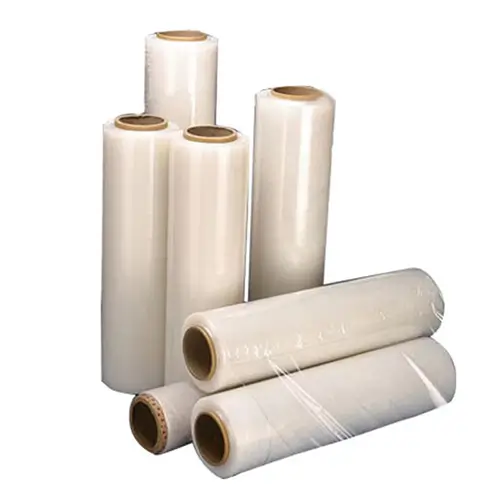
It’s a highly stretchable plastic film, typically made from polyethylene (like LLDPE – linear low-density polyethylene). When you stretch it, the film can grip iteself layer by layer and the load is stabilized and hugh together. The tensile force can reach 100%-150%, or even higher. You can use the plastic film by hand or pallet wrapper machines.
Key Properties
- High Stretchability: Stretch to 100-150% of the original length, or even 200-300%.
- Strong and Puncture Resistance: It can withstand the friction, impact and sharp edges generated during transportation.
- Great Transparency: It is convenient to identify the contents of the pallet and facilitate inventory management.
- Elastic Memory: The packaging film can retract when stretched, providing continuous and stable tension to ensure the safety of the load.
Types of Stretch Wrap
- Hand Stretch Film: Manual winding, suitable for small batch or scattered load.
- Machine Stretch Film: Specially designed for automatic or semi-automatic pallet wrapper machines. It offers enhanced stretch force and maintains consistent tension during stretching, making it ideal for large-volume operations.
Applications
- Pallet Unitization: Fixing and protecting various boxes, containers or individual items (especially irregularly stacked or mixed goods) placed on pallets to prevent displacement or collapse during transportation.
- Secure Heavy, Unstable Loads: It is the preferred choice for stabilizing large, heavy or irregularly shaped pallet loads.
- Bundling & Grouping: Securing groups of lumber, pipes, or smaller boxes together before placing them on a pallet or for in-plant movement.
What’s Shrink Wrap?

Shrink film is a thermoplastic film that is activated by heat. It is usually heated by a hot air gun or a contraction tunnel. After heating, it shrinks and closely adheres to the wrapped items, playing a protective role. Made from materials like Polyvinyl Chloride (PVC), Polyolefin (POF), or Polyethylene (PE), shrink wrap is manufactured in a stretched state.
Key Properties
- Shrinkage Force: Typically, a shrinkage of 30% to 70% occurs after heating.
- Fit Complex Shapes: It can perfectly wrap irregularly shaped items and provide a smooth, professional surface.
- Tamper-Evident Seal: After shrinking and cooling, it forms a distinct seal. Once damaged, it is easy to identify, enhancing product safety (especially for retail goods).
- Barrier Performance: Effectively blocks moisture, dust, dirt and other contaminants, protecting sensitive products (such as food, medicine, electronic products).
Applications
- Single Product/Small Item Bundling: Create retail multi-piece packaging, such as beverage bottle combinations.
- Protecting Small and Irregular Items: Providing customized protective layers for equipment, components, etc. with irregular shapes.
- Food Packaging and Tamper-Proofing: Widely used in the food industry, it ensures hygiene, freshness and provides a guarantee against opening.
Stretch Film vs. Shrink Wrap
| Feature | Stretch film | Shrink wrap |
|---|---|---|
| Core mechanism | Mechanical stretch & elastic recovery | Heat-activated contraction |
| Heat required | No | Yes |
| Look & feel | Functional cling, secures load | Glossy finish, conforms tightly, seals |
| Primary purpose | Containment & Unitization | Conformation, sealing & protection |
| Best for | Pallet wrapping, bundling, securing loads | Product packaging, tamper-evident seals |
| Application device | Hand rollers, pallet wrappers (manual/auto) | Heat guns, shrink tunnerls, ovens |
| Cost consideration | It is usually more cost-effective for large pallet loads (high tensile rate means less material consumption, and automation can improve efficiency). | The cost varies greatly (due to different materials), and the packaging cost of a single product may be higher. However, its special functions (anti-opening, appearance, and barrier) are worth the money in specific applications. |
Heat Activation (Needed or Not)
Stretch film: Absolutely no heat required. Its power comes solely from mechanical stretch and elastic recovery.
Shrink wrap: Shrink film mainly contracts and squeezes together by heat activation. It simply won’t shrink and conform without it.
Containment vs. Conformation
Stretch film: Its job is to hold multiple items together tightly as a single, stable unit (palletizing, bundling). It prevents shifting and protects edges but doesn’t necessarily create a sealed environment around individual items.
Shrink wrap: Its job is to create a tight, sealed barrier around an item or group of items, conforming precisely to its shape. It protects from dust, moisture, tampering, and offers a finished presentation.
Elastic Memory vs. Shrink Power
Stretch film: It’s designed to be stretched significantly and hold that tension over time.
Shrink wrap: It’s manufactured in a stretched state. Heat triggers it to return to its “remembered” smaller size. Its core feature is its ability to contract dramatically under heat.
Application Method: Hand/Machine Wrapping vs. Heat Tunnels/Guns
Stretch film: Stretch wrap can be applied by various equipment, like hand application, manual dispensers, semi-automatic pallet wrappers, and fully automatic robotic wrappers.
Shrink wrap: For small-scale tasks, a handheld heat gun is sufficient. For large-scale or high-efficiency operations, heat shrink tunnels and shrink ovens are required
Typical Thickness & Gauge
Stretch film: Generally thinner gauges, measured in microns (µm) or mils. Hand film might be 12-20µm, heavy-duty machine film up to 35µm+. Stretch wrap’s gauge is chosen based on load weight and stability needs.
Shrink wrap: Generally thicker gauges than standard stretch film, also measured in µm or mils. Common ranges are 25µm to over 150µm for heavy-duty applications. Thickness relates to puncture resistance and the required shrink force.
Going Green: Sustainable Options for Stretch & Shrink
Compostable Stretch Wrap
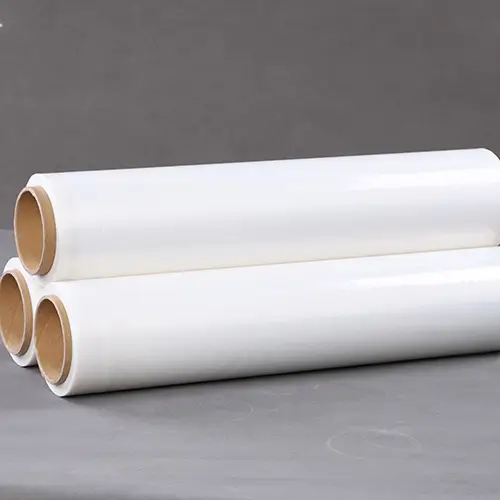
Compostable stretch film can decompose naturally under the specific composting condition, reducing the landfill waste. Crafted from PLA and PBAT, the stretch wrap film offer a sustainable solution for industrial packaging. It offers the same load security and performance you’d expect from traditional stretch film, but with a much gentler impact on the planet. It’s a win-win for businesses and the environment.
Compostable Shrink Film
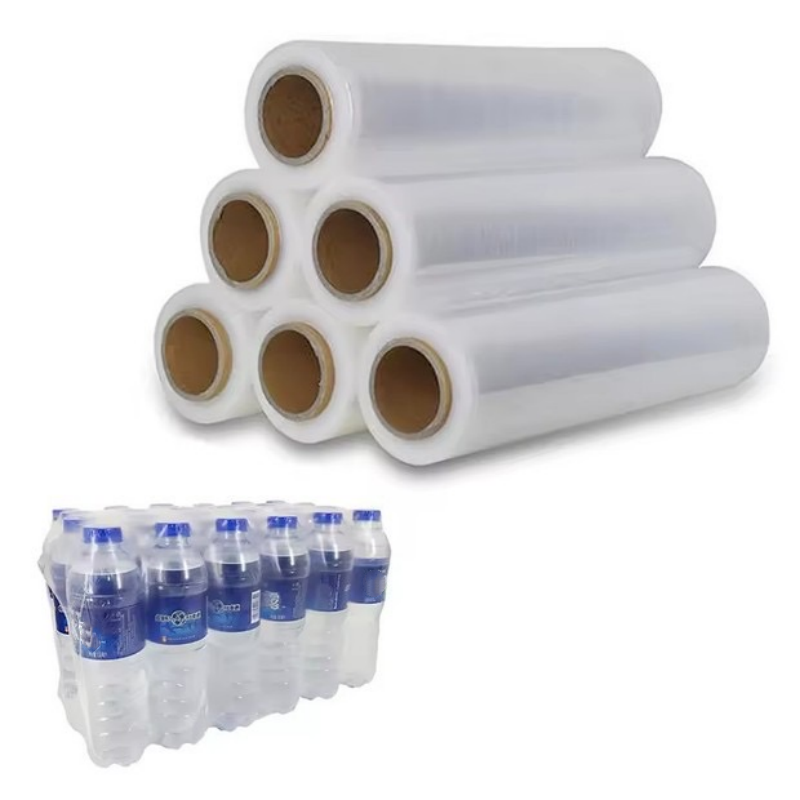
Compostable shrink film is also made from PLA and PBAT polymers. Its shrink force and sealing strength are no different from those of traditional heat shrink films. The only possible drawback is that it is slightly less transparent. It can be composted in industrial composting facilities, forming a closed-loop system, which is an important practice for the development of a sustainable circular economy.
Selection Guide: Which One Do You Need?
So, how do you navigate the world of packaging films and ensure you’re picking the best solution for your distribution or manufacturing needs? It really comes down to understanding your specific requirements.
Key Considerations
- Packaging object: Is it heavy or large items on the pallet or individual small products?
- Shape: Regular box or irregular shape?
- What kind of protection is needed: Only to prevent the shift or offer strong protection against punctures and tears?
- Is tamper-proofing crucial, especially for retail goods?
- Sustainability goal: Whether there is a tendency to seek packaging materials that reduce environmental impact?
- Budget and output: Machine stretch film may be more suitable for large batches, while for small batch operations, manual stretch or specialized shrink film can be used.
- The current packaging system: Do you have a pallet wrapping machine already? Or a heat gun for shrink wrapping?
Conclusion
Let’s nail it down simply. The absolute core difference in the stretch film vs shrink wrap question?
- Stretch film is applied under tension (cold) and holds that tension to contain and unitize loads. No heat!
- Shrink wrap is applied loosely and requires heat to contract and conform, creating a sealed, protective barrier around items.
Stretch and shrink films are complementary rather than alternative packaging solutions. Only by understanding their working principles, core features and best application scenarios, and combining them with the characteristics of one’s own products, transportation needs and sustainable goals, can the best choice be made to ensure the safety of goods, reduce costs and enhance customer satisfaction.