
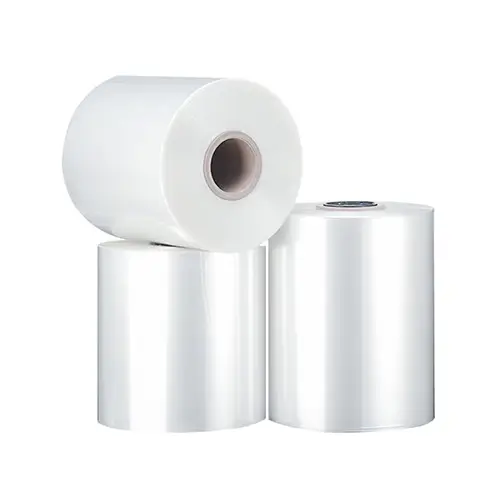

Compostable film does not seal like polyethylene, and most failures are not the film’s fault. Blends of PLA, PBAT and starch typically seal 20 to 40°C lower than LDPE, in a window a third as wide, with noticeably lower hot tack. Put a roll on a line that was tuned for PE and it will burn on one bag and peel on the next.
The fix is almost always a proper temperature ladder run on your own machine, not a new supplier. Here is how the material behaves, what actually goes wrong, and how to find your window in under an hour.
Why compostable film is not polyethylene
Polyethylene is forgiving. It has a broad melting range, high hot tack, and enough melt strength to hold a seal while it cools. Compostable blends are less cooperative for three reasons.
They melt lower. PLA softens around 55 to 60°C and melts in the 150 to 170°C range, but the sealant layer, usually PBAT or a starch blend, activates well below that, often from 90°C. The gap between “seals” and “sticks to the jaw” can be 15°C.
They have weaker hot tack. Hot tack is the strength of the seal while it is still molten. PE holds; compostable film is still soft when the jaw opens, so a bag filled fast can pop the seal open before it sets. You compensate with dwell time and pressure, not just temperature.
They are more sensitive to moisture and surface condition. Starch-based films pick up water, and water turns to steam at seal temperature. Steam under a jaw produces a blister, and a blister is a leak.
Whether the film was made by blown film extrusion or cast film extrusion, the downstream behavior is the same. Compostability is a separate matter from sealability, too — the BPI certified product directory tracks the former, not the latter. European Bioplastics keeps fact sheets on these materials if you want the polymer-level detail.
One more thing worth knowing before you blame the film: many compostable structures are sealable on one side only. If the roll is wound with the sealant layer facing out and the operator seals face-to-face the wrong way, you get a neat-looking seal with almost no strength.
The sealing window
These are typical starting ranges for the common families. Treat them as a place to begin your ladder test, not as specifications.
| Material | Seal initiation | Practical window | Watch for |
|---|---|---|---|
| LDPE (reference) | 110–130°C | 30–50°C wide | Very forgiving |
| Starch blend | 100–125°C | 15–25°C wide | Blocking, blisters, weak peel |
| PLA-rich | 90–120°C | 15–20°C wide | Jaw sticking, brittle seal edge |
| PBAT-rich | 85–115°C | 20–30°C wide | Stretching in the jaw |
If your line is set to 145°C because that is what the PE job needed, you are 20 to 50°C above where a compostable film wants to be. That is the whole problem in one sentence.
Four failure modes and what they actually mean
1. The seal peels cleanly open
You get two intact surfaces and no bond. Temperature is too low, dwell is too short, or you are sealing the non-sealable face. Check temperature and dwell first. If both are in range, flip one sample over and seal again. If it bonds, it is a face-orientation problem, not a material problem.
2. The seal edge is brittle and splits
Temperature is too high. The film has melted through the sealant layer and the molecular orientation is gone, so the seal line becomes the weakest point in the bag. Lower the temperature by 10°C and add dwell instead. This is the most common mistake when operators “fix” a weak seal by turning up the heat.
3. The film sticks to the jaw and stretches
Compostable film adheres to hot metal. Three fixes, in order of cost: lower temperature with longer dwell, PTFE-coated jaws, or a chilled back-up bar. On older constant-heat band sealers this can be the limiting factor, and impulse sealing is often the cheaper route.
4. Bubbles or white blisters along the seal
Moisture. Either the film has absorbed water in storage or the product being packed is releasing it. Dry the roll, check storage conditions, and if the problem persists after a dry night, ask for a film with a different sealant layer.
A fifth cause worth ruling out early: powder contamination. Starch dust or slip-agent bloom on the sealing surface acts as a release layer. Wipe a sample with a dry cloth and re-seal. If it now bonds, the problem is handling, not material. Slip and anti-block additives come from the masterbatch, so this is where formulation shows up in the field.
Run a temperature ladder in ten minutes
Do this on your own machine, with your own film, before changing anything else.
- Set dwell to 0.6 s and pressure to 0.3 MPa. Keep them fixed for the whole test.
- Start at 90°C. Seal one sample. Raise the jaw temperature by 5°C and seal another. Continue to 160°C.
- Let each sample cool for ten seconds, then peel it by hand at roughly 180°. Rate each one: no bond, partial, strong, or burnt.
- Mark the band where the seal is strong. It is usually 20 to 25°C wide.
- Set the machine to the middle of that band, not the edge. The edge moves when ambient temperature, line speed or film lot changes.
- Repeat at your real line speed. Dwell time is what changes when you speed up, so the band shifts.
Write the result on the machine card. The next operator will need it.
If you are buying film rather than making bags
If you are still choosing, start with which film suits bag making. Once you have a structure in hand, ask for four numbers before you run a trial. A supplier who has them is a supplier who has run the trial before.
- Seal initiation temperature for the specific structure, not the material family.
- Recommended dwell and pressure at your line speed.
- Hot tack value, if they have it, or at least a statement of how the film behaves on a vertical form-fill-seal machine.
- Which side is sealable, and the orientation of the roll.
Two more questions that separate a trading company from a manufacturer: what happens to the seal after 30 days, and does the film need corona treatment before printing. Treatment decays over time, which is why printed stock that sat for six months can fail where fresh stock did not.
When tuning stops working
If the ladder test produces no strong band at any temperature, stop adjusting the machine. Four structural causes are more likely than a setting:
- Face orientation: the sealant layer is on the wrong side, or the film is single-side coated and the roll is unwound backwards.
- Gauge: too thin for the fill weight. No temperature will fix a seal that cannot carry the load.
- Jaw geometry: narrow jaws need higher pressure, and higher pressure on soft compostable film stretches it before it bonds.
- Age: the film is past its usable life and the sealant has already absorbed moisture or begun to cross-link. See compostable bag shelf life for how to spot this before it reaches the line.
Test in that order. Replacing the roll is almost always cheaper than a week of trial-and-error on the line, and it tells you whether the problem is the material or the machine.
Frequently asked questions
At what temperature should I seal compostable film?
Typically 90 to 130°C depending on the formulation, with the usable window often only 15 to 25°C wide. Always run a ladder test; the number on the TDS is a starting point.
Can I use my existing PE bag-making machine?
Usually yes, with a lower temperature setting, longer dwell and often PTFE jaw covers. The mechanics do not change; the settings do.
Why does my seal look fine but fail in transit?
Seal strength after cooling is lower than it looks when warm. Run a peel test the next day, not immediately, and check whether the seal edge has crystallized.
Does corona treatment matter for sealing?
For printing, yes, and treatment decays with time. For sealing, what matters is which face carries the sealant layer. Do not confuse the two.
Will a stronger seal make the bag stronger?
Only up to a point. Past the optimum, the seal line becomes brittle and the bag fails there instead of at the body. The goal is a seal as strong as the film, not stronger.
How do I compare two suppliers’ films?
Same machine, same settings, ladder test on both, then a 24-hour peel test. Anything else is opinion.