
In the current landscape of facility management, sustainability is no longer a “nice-to-have” feature; it is a regulatory and operational mandate. As landmark legislation like California’s SB 1383 and New York City’s organic waste laws tighten their grip, procurement managers are searching for waste solutions that balance environmental ethics with industrial-grade performance.
Transitioning to compostable drawstring trash bags is one of the most effective ways to meet these demands. Certified compostable liners offer more than just a lower carbon footprint—they are a strategic tool designed to optimize labor, reduce hauling costs, and eliminate contamination in your waste stream.
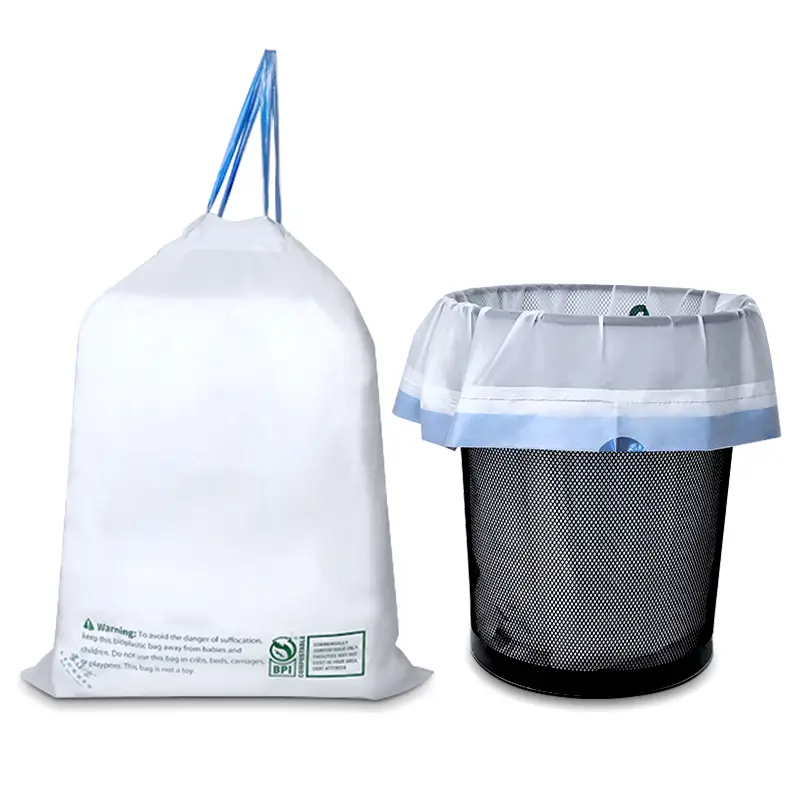
Why Your Facility Needs Compostable Drawstring Trash Bags?
When managing high-traffic environments like stadiums, hotels, or corporate campuses, the “green” alternative must perform under pressure. Traditional plastic liners contribute to the global plastic crisis, but standard flat-top compostable bags often fail the durability and efficiency test.
By switching to compostable drawstring trash bags, you bridge the gap between environmental compliance and operational excellence. These bags ensure that your facility remains ahead of the curve, “future-proofing” your operations against evolving waste mandates.
Benefits of Using Compostable Drawstring Trash Bags
Here is how compostable drawstring bags specifically improve waste management for commercial facilities.
Maximizing Labor Efficiency with Drawstring Compostable Liners
In facility management, labor is your highest expense. Every second spent on waste handling is a second taken away from maintenance and guest services. Here is how compostable drawstring trash bags specifically improve the “second-per-bin” metric:
- Faster Turnaround Times
Staff can cinch, lift, and replace a drawstring bag in roughly 30% less time than a flat-top bag that requires manual knotting. In a 500-room hotel or a large-scale commercial kitchen, those saved seconds translate into weekly labor-hour reductions.
- No “Tail” Waste
To tie a standard flat-top bag, staff often leave the top 20% of the bag empty to have enough material to tie a knot. Drawstrings allow the bag to be filled to its true capacity. This means fewer bag changes, less material waste and a more cost-effective use of your inventory.
Streamlined Waste Diversion & Sorting
The biggest failure in any composting programs is contamination. If non-compostable plastic enters the organic stream, the entire load may be rejected and sent to a landfill.
- Visual Cues: High-quality compostable bags are typically translucent green or clearly printed with certification logos. This acts as a visual “gatekeeper,” ensuring janitorial staff and users don’t accidentally toss recyclables or landfill waste into the organics stream.
- Closed-Loop Logistics: Because the bag itself is compostable, the entire unit (bag + organic waste) moves from the bin to the hauler to the industrial composter without ever being opened. This eliminates the “de-bagging” step required for non-compostable liners, which is a major point of contamination and extra cost at processing facilities.
Advanced Hygiene and Odor Control
Organic waste is heavy, wet, and odorous. This is where the performance features of compostable drawstring trash bags become essential for maintaining a sanitary facility.
- Breathability vs. Sealing: Many industrial compostable bags are “breathable,” allowing moisture to evaporate rather than pooling at the bottom. By drying out food waste, you can slow down the anaerobic processes that cause foul odors, leading to a fresher-smelling loading dock and kitchen.
- The 3-Layer Seal: Drawstring bags often feature a reinforced 3-layer top. When cinched, the drawstring creates a tighter seal than a hand-tied knot. This effectively locks in odors and prevents pests (flies/rodents) from accessing the waste while it awaits collection.
Lowering Tipping Fees: How Compostable Bags Reduce Waste Weight
Waste management is often billed by weight, not volume. This is where the financial benefits of compostable drawstring trash bags become most apparent.
Since compostable resins (like PLA and PBAT) allow for higher moisture vapor transmission than traditional plastic, the “wet” weight of food scraps decreases as they sit in the bag.
For a high-volume kitchen or cafeteria, a 5–10% reduction in waste weight due to evaporation can lead to thousands of dollars in savings on annual hauling and compost tipping fees. By using compostable garbage bags, you are literally evaporating your waste costs.
Regulatory Compliance and Future-Proofing
Using certified compostable drawstring trash bags (BPI or ASTM D6400 certified) ensures that your facility remains compliant with local hauler requirements. Furthermore, for B2B purchases under pressure to hit ESG (Environmental, Social, and Governance) targets, these bags provide measurable data.
You can track exactly how many tons of organic waste were diverted from the landfill by using a dedicated compostable liner system. This transparency is invaluable for annual sustainability reports and corporate branding.
Summary
Switching to compostable drawstring trash bags creates a “triple win” for your organization:
- Staff love them because the drawstring design prevents breakage and eliminates the need for difficult knots.
- Operations loves them because they reduce frequent bin cleaning and improve odor control.
- Finance loves them because they reduce waste weight and ensure the facility avoids heavy fines for non-compliance.
Frequently Asked Questions
Q: Are compostable drawstring trash bags worth it?
A: Yes. While the unit price may be higher than traditional plastic, the ROI is found in reduced labor hours, lower waste weight (tipping fees), and the avoidance of regulatory fines.
Q: Are compostable drawstring trash bags as strong as plastic?
A: Modern compostable drawstring trash bags offer high puncture resistance and weight capacities that rival traditional high-density polyethylene (HDPE) liners.
Q: Do compostable bags have a shelf life?
A: Yes. Because they are designed to break down, compostable bags typically have a shelf life of 10 to 12 months. To ensure maximum strength, they should be stored in a cool, dry place away from direct sunlight.
Looking to optimize your facility’s waste management? Contact our team today to sample our compostable drawstring trash bags and see the “Seconds-Per-Bin” difference for yourself.