
In terms of waste management, the difference between a successful cleanup and a costly disaster often comes down to a fraction of an inch. While most people choose bags based on gallon size, the true measure of a bag’s reliability is its thickness.
Why Trash Bag Thickness Matters
Trash bag thickness determines exactly how much stress the plastic can handle before its molecular bonds “zipper” and fail.
You may have seen a situation that a janitorial staff is hauling a bag to the dumpster, only for a sharp corner of a plastic container pierces the side. In a split second, that tiny puncture “zippers” down the side of the bag. Within five seconds, the floor is covered in waste, liquid, and debris.
This happens because the trash bag thickness wasn’t matched to the waste type. Whether you are managing office paper or heavy industrial scraps, your choice of gauge is the primary defense against punctures and tears. As a supplier or business owner, your goal is to find the perfect balance where the bag is thick enough to ensure high puncture resistance but lean enough to remain cost-effective.
Understanding Trash Bag Thickness
When you come to trash bags, you’ll run into two main units of measurement: mils and microns.
What is a “Mil”?
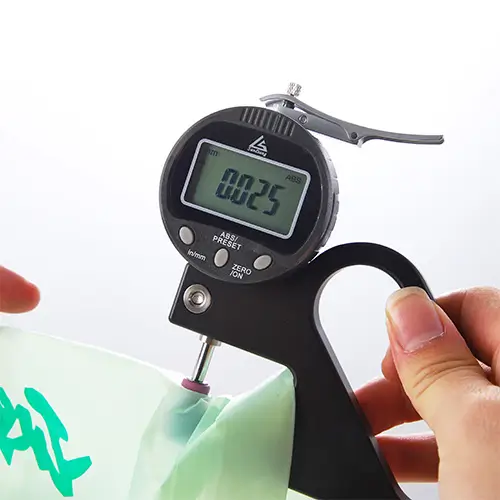
A “mil” is a unit of measurement used primarity for low-density bags. It is equal to one-thousandth of an inch (0.001″).
When you see a bag labeled as 1.5 mil, it’s thick enough to handle some serious weight and sharp edges. Most kitchen bags you find at the grocery store hove around 0.7 to 0.9 mil. If you’re dealing with heavy-duty construction debris, you’re looking at 3.0 mil or higher.
What is a “Micron”?
While mils are the standard measurement in the U.S., “microns” (or micrometers) are the metric equivalent. One micron is one-thousandth of a millimeter.
Usually, the term “micron” is reserved for high-density trash bags—those thin and crinkly liners in office wastebaskets or bathroom bins. These bags are incredibly strong for their weight, but they don’t have the stretch of a mil-rated bag.
The Quick Conversion Guide: Mils, Microns, and Millimeters
If you’re a distributor dealing with international manufacturers or various product lines, you’ll need to convert these numbers on the fly. Here is a handy rule of thumb:
- 1 mil = 25.4 micron
- 1 mil = 0.0254 millimeters
- 1 micron ≈ 0.39 mil
| Mil | Micron | Millimeters (mm) | Common Use |
| 0.35 mil | 9 microns | 0.009 mm | Light office waste |
| 0.70 mil | 18 microns | 0.018 mm | Standard kitchen |
| 1.0 mil | 25.4 microns | 0.025 mm | Heavy-duty commercial |
| 2.0 mil | 51 microns | 0.051 mm | Contractor/Industrial |
Material Matters: How Thickness Interacts with Plastic Resins
Trash bag thickness isn’t the only thing that dictates performance; it’s also about what the bag is made of. Not all thickness is created equal.
Low-Density vs. High-Density
- Low-Density (LDPE/LLDPE): These are the stretchy bags. Because the molecules are spread out, they can take a hit from a sharp object and “give” a little bit instead of tearing. For these bags, a higher trash bag thickness directly translates to better puncture resistance.
- High-Density (HDPE): These are the crinkly, paper-thin bags. They can hold a surprising amount of weight—sometimes more than a thicker LDPE bag—but they have zero “give.” If a sharp object pokes a hole, the whole bag zippers.
Compostable Trash Bags and the Thickness Variable
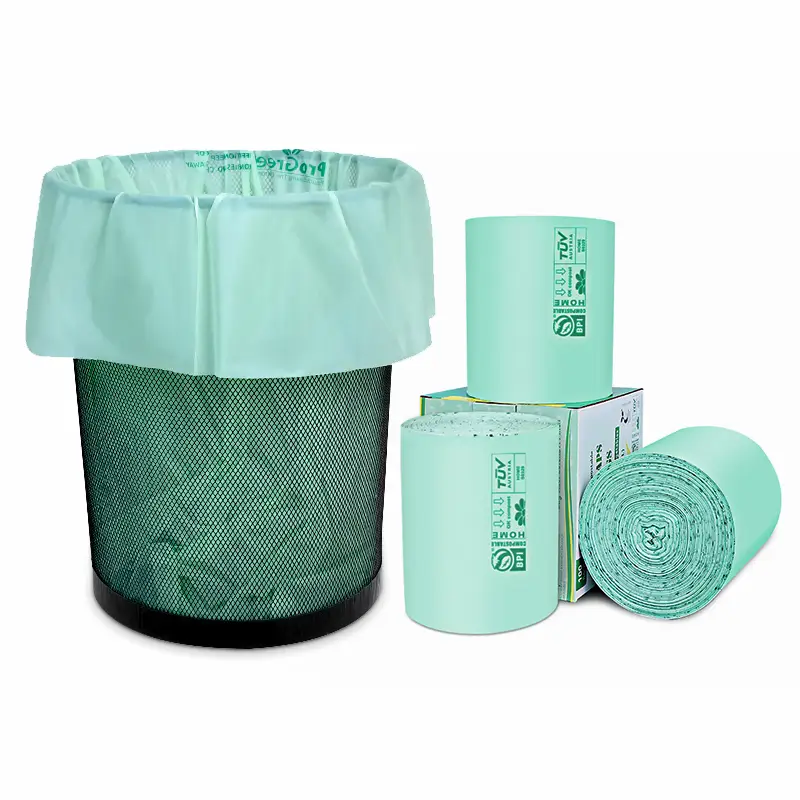
Compostable trash bags are a different beast entirely. Most these bags are made from blends of PBAT, PLA, and cornstarch.
Historically, compostable resins were weaker than traditional plastic. To get the same performance as a 0.9 mil plastic bag, you might have needed a 1.1 or 1.2 mil compostable bag. However, technology is catching up! Modern compostable bags are becoming much more efficient. Still, because these bags are designed to break down, the thickness plays a huge role in shelf-life and moisture resistance. If a compostable bag is too thin, it might start “sweating” or breaking down prematurely if you put wet food scraps in it.
How Thickness Directly Impacts Performance
Weight Capacity
Generally, thicker bags have excellent load-bearing capacity. If you need to transport heavy garbage, you should choose the thicker bags for effective waste management. These bags have more molecular connections to distribute the weight and keep the garbage in the correct position.
Puncture & Tear Resistance
Thicker garbage bags can withstand greater tearing force because their stretchable material allows the pressure to be dispersed. For sharp and heavy waste, thinner liners are prone to tearing and cracking because they cannot withstand punctures and excessive weight.
Leak Prevention
Thicker bags provide a more substantial barrier against moisture. For businesses using compostable trash bags for food waste, thickness is vital because organic waste is heavy and wet. You need that extra gauge to ensure the bag doesn’t leak before it hits the compost bin.
The “Double-Bagging” Trap
In warehouses, workers will take two thin bags and put one inside the other because they don’t trust the bag to hold. Buying a single 1.5 mil bag is almost always cheaper than buying two 0.7 mil bags. Plus, it’s half the labor and half the plastic waste. “Right-gauging” your trash bag thickness is one of the easiest ways to cut costs immediately.
Application Guide: Choosing the Right Gauge for Every Bin
Not every bin needs a heavy-duty liner. In fact, using a thick bag where a thin one will do is just throwing money in the trash.
Light Duty (0.3 – 0.5 Mil / 6-10 Microns)
These are for your “soft” trash.
- Best for: Paper, tissues, bathroom waste, and shredded documents.
- Where to use: Office cubicles, hotel rooms, and powder rooms.
Medium Duty (0.7 – 0.9 Mil / 11-15 Microns)
This is the most standard trash bag thickness.
- Best for: General household waste, food scraps (without sharp bones), and light packaging.
- Where to use: Breakrooms, residential kitchens, and small retail shops.
Heavy Duty (1.0 – 1.5 Mil)
- Best for: Heavy food waste, wet grass clippings, and bulkier packaging.
- Where to use: Restaurants, schools, and industrial facilities.
At this thickness, you get a great balance of stretch and strength. It can handle a gallon of spoiled milk or a pile of wet paper towels without flinching.
Contractor Grade (2.0 – 4.0+ Mil)
If you could use the bag as a makeshift tarp in a pinch, it’s probably contractor grade.
- Best for: Construction debris, glass, nails, jagged wood, and heavy metal scraps.
- Where to use: Construction sites, demolition projects, and heavy manufacturing.
These bags are almost impossible to tear by hand. They are the “tanks” of the trash bags world.
The Economics of Thickness: Saving Money by “Right-Gauging”
For distributors or wholesalers, “right-gauging” is the holy grail of procurement. It’s the process of finding the exact trash bag thickness needed for a specific application.
Avoid Over-Specifying
I once worked with a client who was using 2.0 Mil bags for their office paper waste. They thought they were being “safe.” We switched them to a 10-micron high-density bag. The result? They saved 40% on their annual waste management budget and used 50% less plastic. Don’t buy a sledgehammer to drive a thumbtack.
Hidden Cost of Under-Specifying
On the flip side, trying to save pennies by buying thin bags for a commercial kitchen is a recipe for disaster. If a bag breaks, you aren’t just losing the cost of the bag. You are paying for:
- The labor time for a worker to clean up the mess.
- Cleaning supplies (sanitizer, mops, degreaser).
- The cost of the second (and third) bag used to fix the mistake.
- Potential slip-and-fall liability if the leak isn’t caught.
The Environmental Angle
This is a question we get a lot in the compostable trash bags sector. Does a thicker bag take longer to break down?
Technically, yes. A 2.0 mil compostable bag has more mass for microbes to eat than a 5.0 mil bag. However, reputable manufacturers (like those certified by BPI or TUV Austria) ensure that even their thickest bags meet the timeframes required for industrial composting facilities.
When you choose the right trash bag thickness, you are also helping the environment. By avoiding double-bagging and “bag fails”, you’re ensuring that the least amount of material possible is used to get the job done. That’s the definition of sustainbility.
Conclusion
It is time to stop viewing trash bags as a simple commodity and start seeing them as a critical performance tool. When you align your bag’s mil thickness with the specific demands of your facility, you do more than just prevent messes—you actively protect your bottom line.
Getting the thickness right is a proven strategy for operational cost-efficiency. By selecting the correct gauge, you eliminate the need for “double-bagging,” reduce janitorial labor hours spent on cleanup, and minimize the risk of workplace slip-and-fall hazards caused by leaking waste. Whether your team is handling lightweight office paper or jagged construction debris, the right specs ensure the job is done once and done right.
Ready to find the perfect fit for your business?
Whether you are sourcing heavy-duty industrial liners for maximum durability or exploring the latest in BPI-certified compostable trash bags for your sustainability goals, remember: the “mil” matters. Don’t leave your waste management to chance—choose the thickness that matches your mission.