
It’s stuffed to the brim with a tangled, chaotic mess of plastic bags from every takeout meal you’ve ordered. For decades, the “plastic bag” was the unsung hero of the food service industry—cheap, strong, and plentiful. But times are changing, and they’re changing fast.
If you’re a distributor or a restaurant owner, you’ve probably noticed that customers aren’t just looking at the food anymore; they’re looking at what the food comes in. This is where the compostable plastic takeout bags enter the stage. It’s not just a trend; it’s an evolution.
The Evolution of Food Delivery Packaging
Remember when everything came in white Styrofoam clamshells? It felt high-tech back then, didn’t it? But as our oceans and landfills started crying for help, the industry had to pivot. The rise of delivery apps like UberEats and DoorDash turned every restaurant into a high-volume packaging house.
The evolution hasn’t been a straight line. We went from paper (which leaks) to plastic (which lasts forever) to what we have now: high-performance compostable plastic takeout bags. These are the “smart” versions of the bags we used to know. They look like plastic, they feel like plastic, but they don’t act like plastic when you’re done with them.
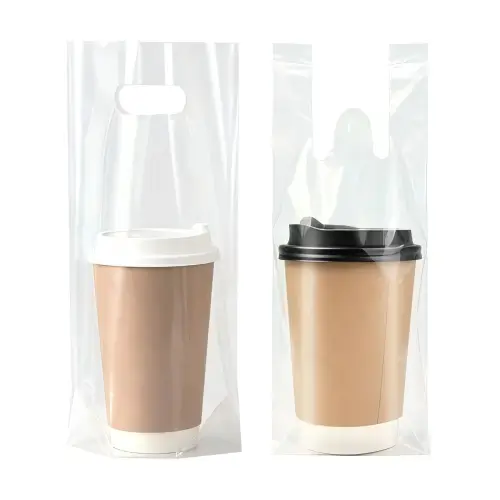
What Are Compostable Plastic Takeout Bags?
So, what exactly are we talking about when we say compostable plastic takeout bags? It sounds like a bit of a contradiction, right? “Compostable” and “Plastic” usually don’t sit at the same table.
The Science of Bio-based Polymers
Unlike traditional bags made from crude oil (petroleum), these bags are born from plants. We’re talking about bio-based polymers. Scientists have figured out how to take things like cornstarch, sugar cane, or even vegetable oils and turn them into long molecular chains that behave just like polyethylene. It’s like a magic trick, but with chemistry.
The Difference Between Compostable, Biodegradable, and Oxo-degradable
This is where it gets a little bit “wild west.” People use these terms interchangeably, but if you’re a supplier, you need to know the difference, or you’ll end up with a warehouse full of stuff you can’t sell.
- Biodegradable: This is a broad, unregulated term. Technically, a piece of wood is biodegradable. A leather shoe is biodegradable. It just means it breaks down eventually.
- Compostable: This is a much stricter standard. It means the bag will break down in a composting environment within a specific timeframe (usually 90-180 days) and leave no toxic residue.
- Oxo-degradable: Stay away from these. These are just regular plastics with “shredding” additives. They just turn into microplastics faster. Not good.
| Material Type | Primary Source | End-of-Life Result |
|---|---|---|
| Traditional Plastic | Petroleum | Stays in landfill for 500+ years |
| Compostable Plastic | Cornstarch / PBAT / PLA | Becomes nutrient-rich soil |
| Oxo-degradable | Petroleum + Additives | Microplastics |
Why the Food Service Industry is Making the Switch
Why bother? Well, besides the whole “saving the planet” thing, there are some cold, hard business reasons to invest in compostable takeout bags.
Meeting Consumer Demand for Sustainable To-Go Bags
Have you ever seen a customer’s face when they get a big, greasy plastic bag? Some don’t care, sure. But a growing number—especially Gen Z and Millennials—feel a twinge of “guilt” with every order. When a restaurant uses sustainable to-go bags, they are handing the customer a “guilt-free” experience. It’s a branding win.
Navigating Global Plastic Bans and Regulations
Governments aren’t asking nicely anymore. From New York to Vancouver, and all across Europe, “Single-Use Plastic Bans” are dropping like flies. If you’re a distributor, you don’t want to be caught with a million traditional bags when the law changes overnight. Switching to compostable bags for food takeaway is basically insurance against future legislation.
Key Benefits for Distributors and Suppliers
If you’re a supplier, you might be thinking, “These are more expensive and harder to store.” You’re not wrong, but let’s look at the flip side.
First, the margins on compostable plastic takeout bags are often better because they are a premium product. Second, you become a partner in your client’s success, not just a vendor. When a restaurant needs to meet a new city green-initiative, they’re going to call the guy who already has the certified takeout order bags in stock. You’re not just selling bags; you’re selling solutions.
Technical Specifications: Durability and Performance
This is the part where everyone gets nervous. “Will the bag break?” No one wants a customer’s Thai curry ending up on their driveway because the bag gave up the ghost.
Load-Bearing Capacity for Heavy Takeout Orders
High-quality compostable plastic takeout bags are surprisingly tough. Thanks to a blend of PLA (Polylactic Acid) for stiffness and PBAT (Polybutylene adipate terephthalate) for flexibility, these bags can handle some serious weight. I’ve seen them hold three heavy glass containers without even stretching the handles.
Extended Reading: Can Compostable Takeout Bags Handle Heavy Orders?
Heat and Moisture Resistance for Hot Food Delivery
Hot food creates steam. Steam creates moisture. In the old days, paper bags would just melt under the pressure of a hot pizza box. Sustainable to-go bags made from bio-polymers handle moisture much better. They don’t get “soggy.”
However—and this is a little tangent here—you have to be careful with extreme heat. If you put a bag directly on a literal heating element, it’s going to have a bad time. But for standard food delivery? They’re champions.
Essential Certifications for Quality Assurance
Don’t just take the manufacturer’s word for it. “Greenwashing” is a real problem. If you’re buying compostable plastic takeout bags, you need to see the receipts.
The “Must-Have” Industry Standards
| Certification | What it Means | Who it’s For |
|---|---|---|
| ASTM D6400 | US Standard for Compostability | North American Market |
| EN 13432 | European Standard | EU & International Markets |
| BPI Seal | Verified by the Biodegradable Products Institute | The “Gold Standard” for Trust |
If the bag doesn’t have the BPI logo or a reference to ASTM D6400, it might as well be a grocery bag from 1995. Always check for the “Compostable” seedling logo or the TUV Austria “Home Compost” mark if you want the really good stuff.


Comparing Materials: PLA vs. PBAT vs. Cornstarch Blends
I’ll try not to get too “science-y” here, but it’s important.
- PLA (Polylactic Acid): Made from fermented plant starch. It’s clear and stiff. Great for those transparent takeout order bags.
- PBAT: This is the secret sauce. It’s actually biodegradable despite being oil-based in some cases (though bio-versions exist). It adds the “stretch” and “toughness” that PLA lacks.
- Cornstarch Blends: These are usually opaque and feel a bit “silky” to the touch. They are the workhorses of the compostable plastic takeout bags world.
Most modern bags use a blend. It’s like a recipe—a little bit of this for strength, a little bit of that for flexibility.
Cost vs. Value: The Long-term ROI for Restaurants
Compostable takeout bags cost more than the dirt-cheap plastic ones. Sometimes 2x or 3x more.
But wait, let’s look at the ROI (Return on Investment). If a bag costs $0.05 more, but it allows you to market yourself as an “Eco-Friendly Eatery,” can you raise your delivery fee by $0.10? Absolutely. Most customers are happy to pay a tiny “green premium” if they know they aren’t destroying the planet. For the restaurant, the bag becomes a marketing expense, not just an operational cost.
Marketing Your Eco-Friendly Choice to Customers
If you’re using compostable bags for food takeaway, tell people! Don’t be shy.
- Print it on the bag: A big “I’M COMPOSTABLE” goes a long way.
- Social Media: Post a video of the bag being put into a compost bin.
- The “Small Talk”: Have the delivery drivers mention it. “Hey, by the way, that bag is plant-based!”
It’s all about the story. People love being part of a “good” story.
Storage and Shelf Life Considerations for Suppliers
Here is a little insider tip for the distributors out there. You can’t just throw these bags in a hot, damp shed for three years and expect them to be fine.
- Because they are designed to break down, they have a shelf life. Usually, you’re looking at 10 to 12 months.
- Keep them cool: Heat speeds up the molecular breakdown.
- Keep them dry: Humidity is the enemy.
- Rotate your stock: Use the FIFO (First In, First Out) method.
If you ignore this, you might find that when you go to pull a bag out of the box next year, it crumbles like a dry leaf. That’s a bad day for everyone.
Conclusion: The Future of Compostable Bags for Food Takeaway
At the end of the day, compostable plastic takeout bags represent the bridge between our high-speed, convenient lifestyle and our responsibility to the earth. For distributors, they are a high-growth product category. For restaurants, they are a badge of honor.
We’re moving toward a circular economy. In the future, your takeout order bag won’t be a piece of “trash”—it’ll be the fuel for next year’s crop of corn. And that, I think, is a pretty cool way to look at a simple plastic bag.
So, are you ready to ditch the “drawer of shame” and switch to something better? The tech is here, the quality is high, and the customers are waiting. Let’s make the switch.